

Perps on Hyperliquid: how to trade a real orderbook without handing anyone your keys.
LeoDex now ships a full Hyperliquid perps terminal in beta — live orderbook, up to 40x leverage, TP/SL brackets — with your funds under your own keys. We tell you what Hyperliquid is, how perpetual futures actually work, the risks the marketing skips, and how to place your first trade.
Perpetual futures are crypto's biggest market by volume, and almost all of that volume runs through centralized exchanges — accounts, custody, KYC, and a matching engine you have to trust blind. Hyperliquid rebuilt the whole machine on-chain: a real orderbook, on its own chain, settled block by block. And as of this week, there is a full Hyperliquid perps terminal inside LeoDex — in beta — where the only thing that ever leaves your control is an order.
§ 01 What Hyperliquid actually is
Hyperliquid is not an app on someone else's blockchain. It is a layer-1 built from scratch for one job: running an exchange. Its consensus (HyperBFT) finalizes in one block; its core (HyperCore) runs fully on-chain central limit order books for perps and spot — every order, cancel, trade, and liquidation is a chain state transition, not an off-chain database row. The team claims throughput of 200,000 orders per second; treat the number as their claim, but the design goal is plain: CEX-grade trading without the CEX.01
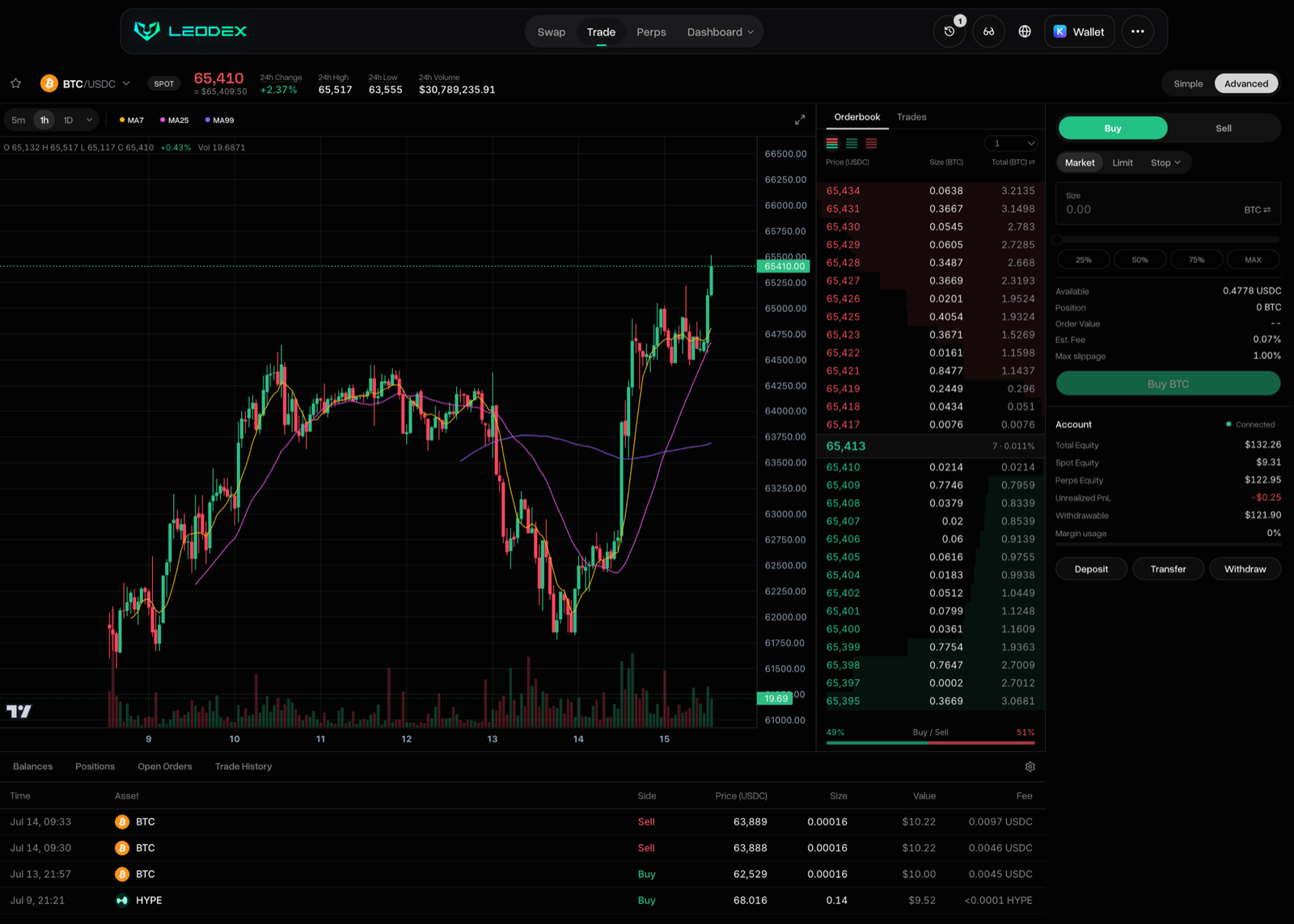
Two more facts explain its gravity. First, it launched with no venture capital — the team self-funded, and in November 2024 it airdropped 31% of the HYPE token supply to roughly 94,000 users, the largest airdrop in crypto history by value. Second, it won: as of mid-July 2026, Hyperliquid holds about $11 billion in open interest, roughly a third of all decentralized-perp volume over the last 30 days ($254B), $6.3 billion in TVL, and 177 live perp markets — BTC up to 40x, ETH up to 25x.06 This is not an experiment anymore; it is the venue.07
§ 02 How perps actually work
A perpetual future is a bet on price with no expiry date. You post collateral (USDC), pick leverage, and open a long or a short many times larger than your margin. Three mechanisms hold the thing together.
Funding. With no expiry, something must tether the perp price to the real one. Every hour, whichever side of the market is "heavier" pays the other: if the perp trades above the spot oracle price, longs pay shorts; below it, shorts pay longs. On Hyperliquid the rate is computed from the premium against a validator-fed oracle of CEX spot prices, paid hourly, capped at 4% per hour — and it flows peer-to-peer between traders. The exchange takes no cut.02
Mark price. Your position is valued — and liquidated — not against the last trade but against a blended mark price that mixes Hyperliquid's own book with prices from Binance, OKX, Bybit and others. That makes it expensive to liquidate someone by briefly shoving one orderbook around.03
Liquidation. Leverage divides your cushion. Maintenance margin on Hyperliquid is half the initial margin at maximum leverage — at 40x, a roughly 1.25% adverse move can end the position. Large positions unwind in chunks rather than all at once, and if the book can't absorb a liquidation, a community-owned backstop vault (HLP, about $255M) inherits it.03 The mechanism works; §03 covers what it costs when it's stressed.
§ 03 The honest limits
Two separate risk conversations, and the marketing usually skips both.
Leverage is the product and the hazard. Most retail traders lose money on leveraged perps — that is not a Hyperliquid problem, it is arithmetic plus human nature. Funding costs bleed positions held against the crowd; a 40x position is a coin-flip away from liquidation on ordinary volatility. Perps are a tool for expressing a view with defined margin, not a way to make spot returns faster.
Hyperliquid's trust assumptions are real. The chain runs 27 active validators, and the Hyper Foundation's own validators hold roughly 45% of active stake; the node software is still closed-source.09 In March 2025, a trader weaponized the liquidation mechanism against the JELLY memecoin market; validators voted — within minutes, off-chain-coordinated — to delist the market and force-settle every position at the attacker's entry price.08 The vault was saved; the episode became the canonical exhibit for "not as decentralized as advertised," and Singapore's MAS put Hyperliquid on its Investor Alert List in June 2026. The counterweight: the protocol has never been hacked, the Arbitrum bridge holding user collateral is audited, and the JELLY-era fixes are structural — on-chain delisting votes, margin tiers that scale leverage down with size, and BTC leverage cut from 50x to 40x. Know both columns before you size a position.
§ 04 What we shipped on LeoDex
The terminal at beta.leodex.io/trade/hl/perp/BTC is the full trading surface, not an embed: live orderbook and trade feed streaming from Hyperliquid, market/limit/stop orders with post-only and IOC, take-profit/stop-loss brackets placed atomically with the entry, reduce-only, cross or isolated margin with per-asset leverage up to each market's cap, estimated liquidation price and fee shown before you submit, and positions, open orders, and trade history underneath.10 The footer says "Data · HyperLiquid" because that is literally what it is — LeoDex does not touch the matching engine.
- Markets
- 177 perp markets from Hyperliquid's live meta — BTC to 40x, ETH to 25x, per-asset caps below that
- Order types
- Market, limit, stop-limit, stop-market · GTC / post-only / IOC · TP/SL brackets · reduce-only
- Margin
- Cross or isolated, integer leverage to each asset's cap, live est. liquidation price on the ticket
- Custody
- Non-custodial — funds sit on Hyperliquid under your wallet; a revocable trade-only session key signs orders
- Fees
- Hyperliquid's base 0.045% taker / 0.015% maker plus a small LeoDex builder fee, shown as one all-in rate on the ticket; no per-trade gas
- Status
- Beta, on beta.leodex.io — spot markets live at /trade/hl as well
The part I care most about is the key model. Trading runs through a session key you approve once with a single wallet signature. That key can place and cancel orders — nothing else. Deposits, withdrawals, and transfers each require a fresh signature from your own wallet, and the session is revocable in one click from the terminal. You get orderbook-speed trading without handing an exchange your funds, because there is no exchange account to hand them to.05
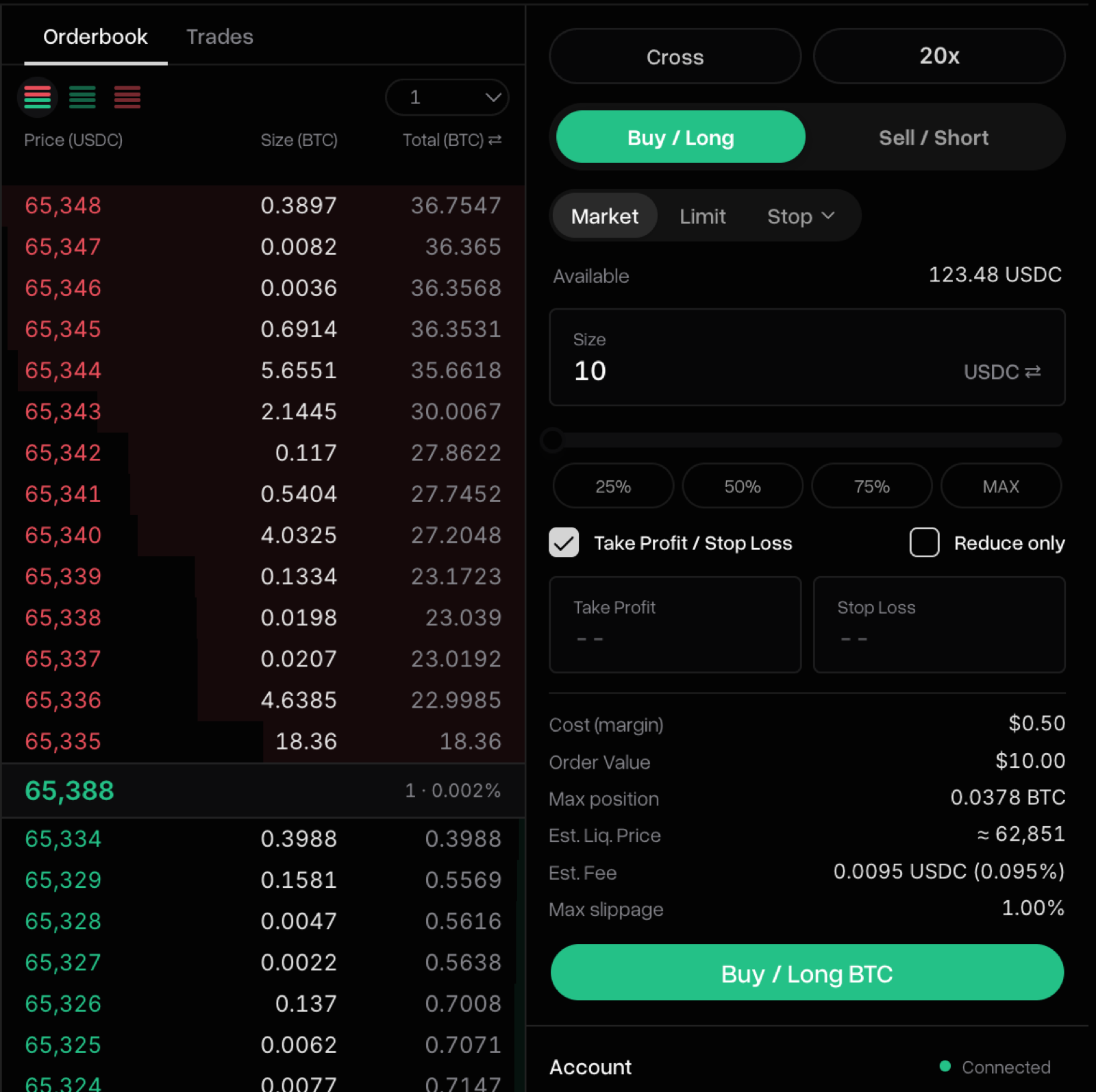
The venue holds the orderbook. You hold the funds. That division of labor is the entire point of doing this on-chain.
On fees, the number in the screenshot above is the whole story. Hyperliquid's base trading fee is 0.045% taker and 0.015% maker, with no gas per trade. LeoDex adds a small builder fee on top — Hyperliquid's own mechanism for the frontends built on it — and the ticket always shows the combined, all-in rate before you submit (0.095% on that BTC long). No hidden markup, no surprise at settlement; the rate you see is the rate you pay.04
§ 05 Your first trade, in six steps
- Open the terminal at beta.leodex.io/trade/hl/perp/BTC and connect an EVM wallet. No account, no KYC.
- Deposit USDC. Collateral is USDC on Arbitrum, moved through Hyperliquid's native bridge — minimum 5 USDC (the bridge burns smaller deposits, so the UI blocks them). No Arbitrum USDC? The deposit dialog links straight into LeoDex's own cross-chain swap, so you can fund it from more than 60 chains.
- Enable trading. One signature approves the trade-only session key described above. Revoke it anytime from the session menu.
- Set leverage and margin mode. Per market, integer leverage up to the asset's cap, cross or isolated. Lower is smarter.
- Place the order. Market, limit, or stop; size in USDC or the asset; optional TP/SL bracket that lands with the entry as one atomic order; reduce-only if you're managing an existing position. Check the estimated liquidation price before you submit — it's on the ticket for a reason.
- Manage and exit. The Positions tab edits TP/SL and closes positions at market or limit. Withdrawals go back to Arbitrum with a wallet signature; Hyperliquid charges a flat 1 USDC.
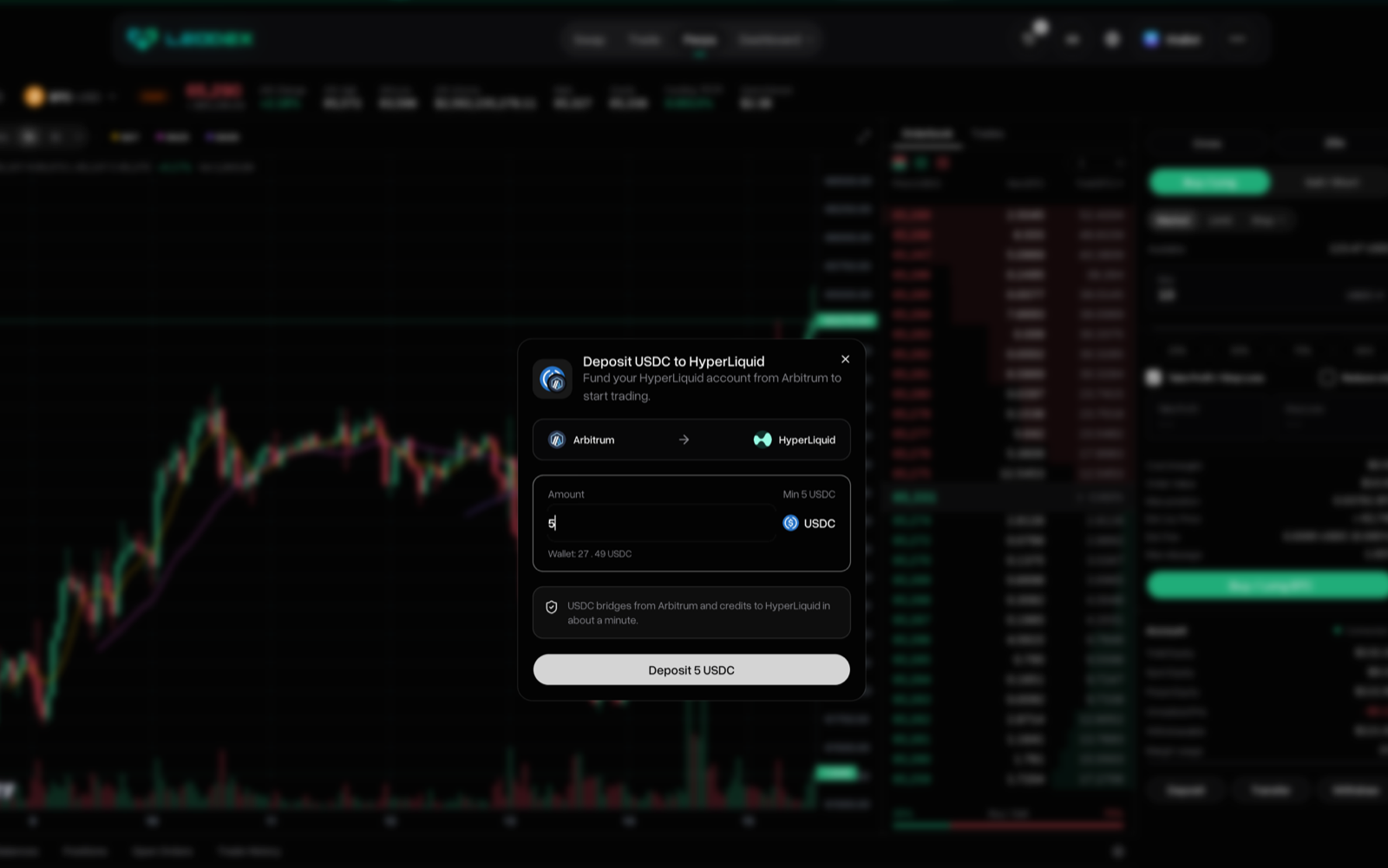

Perps on LeoDex are in beta, and we are explicit about that. The lane, though, is the same one every LeoDex feature lives in: the venue holds the orderbook, you hold the funds.
Survive > maximise. Size like you're wrong. Keep your keys.
Frequently asked questions
Q.Is Hyperliquid a CEX or a DEX?
A DEX with CEX mechanics: a fully on-chain central limit order book running on Hyperliquid's own layer-1. Every order, trade, and liquidation settles on-chain, and funds stay under your own wallet via an audited bridge — there is no exchange account holding your assets.
Q.Is Hyperliquid safe?
The protocol has never been hacked and its Arbitrum bridge is audited, but real trust assumptions exist: 27 active validators (the Foundation holds roughly 45% of active stake), closed-source node software, and the March 2025 JELLY incident where validators force-settled a market. Leverage itself remains the larger risk for most traders.
Q.Do I need KYC to trade Hyperliquid perps on LeoDex?
No. You connect an EVM wallet, deposit USDC, and trade — no account or identity verification. It is pseudonymous rather than anonymous (activity is on-chain), and Hyperliquid's terms restrict some jurisdictions, including the United States.
Q.How do funding rates work on Hyperliquid?
Every hour, the crowded side pays the other: if the perp trades above the oracle spot price, longs pay shorts, and vice versa. The rate derives from that premium, is capped at 4% per hour, and flows peer-to-peer between traders — Hyperliquid takes no cut of funding.
Q.How do I deposit and withdraw?
Deposit USDC on Arbitrum through Hyperliquid's native bridge — minimum 5 USDC — with one wallet transaction; LeoDex's deposit dialog links to its own cross-chain swap if you need to convert from another chain first. Withdrawals return USDC to your Arbitrum address with a wallet signature and a flat 1 USDC fee.
Q.Does LeoDex hold my funds when I trade perps?
No. Your collateral sits on Hyperliquid under your own wallet address. The session key you approve can only place and cancel orders — moving funds (deposit, withdraw, transfer) always requires a fresh signature from your wallet, and you can revoke the session key at any time.
References & Sources
Hyperliquid's own documentation is the source for every mechanism claim (funding, liquidations, fees, builder codes); performance figures from those docs are attributed as team claims in the body. Scale numbers (open interest, volume share, TVL, market and validator counts) were checked against Hyperliquid's public API and DefiLlama on July 14, 2026 — they move daily, so each is dated in the text. Nothing here is financial advice; leveraged trading can lose your collateral quickly. All URLs verified July 14, 2026.
Hyperliquid: Primary Documentation
- [01]“Hyperliquid documentation — HyperBFT L1, fully on-chain order books, throughput claims”. hyperliquid.gitbook.io hyperliquid.gitbook.io/hyperliquid-docs
- [02]“Funding — hourly peer-to-peer rate, premium vs oracle, 4%/hour cap”. hyperliquid.gitbook.io hyperliquid.gitbook.io/hyperliquid-docs/trading/funding
- [03]“Liquidations — maintenance margin, mark price, partial liquidation, HLP backstop”. hyperliquid.gitbook.io hyperliquid.gitbook.io/hyperliquid-docs/trading/liquidations
- [04]“Fees — 0.045%/0.015% base perp tier, fee flows to HLP and the Assistance Fund”. hyperliquid.gitbook.io hyperliquid.gitbook.io/hyperliquid-docs/trading/fees
- [05]“Builder codes — how third-party frontends attach disclosed, user-approved fees”. hyperliquid.gitbook.io hyperliquid.gitbook.io/hyperliquid-docs/trading/builder-codes
Coverage & Data
- [06]“Decentralized perps volume and market share dashboard (live data — figures in this piece dated mid-July 2026)”. defillama.com defillama.com/perps
- [07]“Hyperliquid open interest tops $11B as RWA markets reach all-time high”. cryptotimes.io www.cryptotimes.io/2026/07/13/hyperliquid-open-interest-tops-11b-as-rwa-markets-reach-all-time-high/
- [08]“Hyperliquid delists JELLYJELLY after vault squeezed in $13M tussle — the JELLY incident”. coindesk.com www.coindesk.com/markets/2025/03/26/hyperliquid-delists-jellyjelly-after-vault-squeezed-in-usd13m-tussle
- [09]“Kyle Samani challenges Hyperliquid's permissionless claims — closed-source node, validator-set criticisms”. cryptotimes.io www.cryptotimes.io/2026/06/26/kyle-samani-challenges-hyperliquids-permissionless-claims/
LeoDex
- [10]“Hyperliquid perps terminal on LeoDex — beta.leodex.io/trade/hl/perp/BTC”. beta.leodex.io beta.leodex.io/trade/hl/perp/BTC