

How to add liquidity to Maya Protocol pools — the complete 2026 guide.
How Maya Protocol's Continuous Liquidity Pools actually work, what CACAO is and why every pool needs it, how to add and withdraw liquidity through leodex.io/earn step by step, what yield you should realistically expect on BTC, ETH, DASH, ZEC and RUNE pools, and the Impermanent Loss Protection schedule that THORChain killed and Maya kept.
On May 6, 2026 — yesterday from when I'm writing this — we shipped leodex.io/earn, an open-beta liquidity-pool dashboard that lets you provide and manage liquidity to native cross-chain pools on THORChain and Maya Protocol from a single web UI.41 Right now the dashboard reports $95.37M in dual-LP TVL across both protocols, with 28 depositable pools and 16 deprecated Savers rows we keep visible for transparency but no longer accept new deposits into. About a third of that depositable inventory sits on Maya Protocol, and the Maya pools are the part of the page almost nobody outside the cross-chain native-asset crowd knows what to do with.
That's the gap this guide is for. If you've been holding Bitcoin, Ethereum, Dash, Zcash, or RUNE in self-custody and wondering whether there's a real, native, non-custodial way to earn yield on those assets without wrapping them or shipping them to an exchange — yes, there is, and Maya Protocol is one of only three live protocols in the world where you can do it as a passive retail LP.22 The other two are THORChain (whose Savers single-asset product was permanently deprecated for new deposits in January 2025)33 and Chainflip (whose LP economics are dominated by professional market makers running concentrated-range strategies).37 Cross-chain native-asset LP for retail is functionally a Maya story right now.
Maya does not rely on pegging or wrapping assets, instead managing funds directly in on-chain vaults and safeguarding them through economic security.— Maya Protocol Whitepaper, Introduction
This is going to be the most comprehensive English-language guide to Maya pooling I can write. I'll explain the architecture, the math, the UI, the yields, the risks, and the FAQ. I'll show you exactly what to click on /earn, with screenshots. I'll be honest about where the protocol is small (it is), where the audits are incomplete (the ETH Router report is still labeled Draft on Maya's own audits page),14 and where the math actually works in your favour. By the end of the piece, you should be able to (a) decide whether Maya pooling fits your portfolio, (b) execute a deposit confidently, and (c) know what to monitor afterward.
One quick disambiguation up front, because Google will send some of you here from a confused search query: Maya Protocol — the cross-chain DEX I'm writing about — is not the same thing as Maya, the Philippine fintech bank (maya.ph). It is also not the same thing as the Solana memecoin called "MAYA" that trades on MEXC and Bybit at fractions of a cent. The real MAYA Protocol's CACAO token trades at ~$0.14 on Maya itself. The real MAYA token is OTC-only via official Discord. If you're shopping for "Maya tokens" on a centralised exchange, you're shopping for a different asset.06
§ 01 Why this guide existsThe empty room between Maya's docs and the average user
Maya's own documentation is excellent for engineers and pretty bad for everyone else. The docs explain how memos are constructed, what Mimir is, how the GG20 threshold-signature scheme works, and how liquidity-unit math derives from the constant-product invariant.03 They do not explain, in plain English, what to do when you load leodex.io/earn and see twenty-eight pools with different APYs and you're trying to figure out which one fits your actual portfolio.
The third-party content is worse. Searching "how to add liquidity to Maya Protocol" on Google in May 2026 returns roughly 80% Maya-owned URLs in the top ten — the official docs, the Maya Academy blog, and a fair-launch guide from 2023 that is now hopelessly out of date. The remaining 20% is one ShapeShift landing page and a couple of low-quality SEO-farm Medium posts. There is no Bankless guide. There is no Defiant non-sponsored deep-dive. There is no DeFi Edge tutorial. Every YouTube video on the topic was published in mid-2023, uses the now-defunct THORWallet auction UI, and was made before Arbitrum, Zcash, MOCA, or DASH were integrated.
That's the gap. I'm filling it because I built /earn and I should be able to explain why someone would actually use it, and because the Maya story has changed substantially in the past eighteen months in ways that nobody has really written about yet:
- THORChain Savers — the single-asset, no-IL-exposure cross-chain yield product that hundreds of millions of dollars of deposits flowed into between 2022 and 2024 — was permanently deprecated for new deposits on January 4, 2025 following THORChain's THORFi insolvency event.3336 The displaced demand has nowhere natural to land except dual-LP positions on either chain — and Maya's, uniquely, are still backed by Impermanent Loss Protection.
- Maya kept ILP. THORChain killed it via ADR-005 in November 2023, characterising it as "an outstanding, potentially unbounded liability to the protocol."32 Maya's reserve-funded ILP schedule (50-day cliff, 100% cap, asymmetric daily accrual) is the most underdiscussed structural advantage in the cross-chain LP category.07
- Maya integrated Zcash in May 2025. The ZEC.ZEC pool is now Maya's second-deepest by TVL and its highest-volume by 24-hour turnover — there is no other decentralised venue where native, unwrapped ZEC earns swap-fee yield.30
- Maya's MAYA token tokenomics inspired THORChain's TCY token, which launched in 2025 to repay THORFi creditors. The Maya co-founder Aaluxx wrote THORChain's Proposal 6 introducing TCY modeled on MAYA. The protocol Maya forked from is now copying Maya's design back.24
Most of this is invisible to anyone who isn't in the cross-chain Discord servers daily. So let's start with what you actually see when you load the page.
§ 02 What's on /earnThe page tour
Open leodex.io/earn and you get a sortable, filterable table of every active liquidity pool across THORChain and Maya Protocol. The default view is "All Pools" sorted by TVL descending. The four filter pills below the stats —All Pools, Available, THORChain, Maya Protocol, Savers (Deprecated), and (if your wallet's connected) My Liquidity — let you narrow down to whichever protocol or position view you care about.
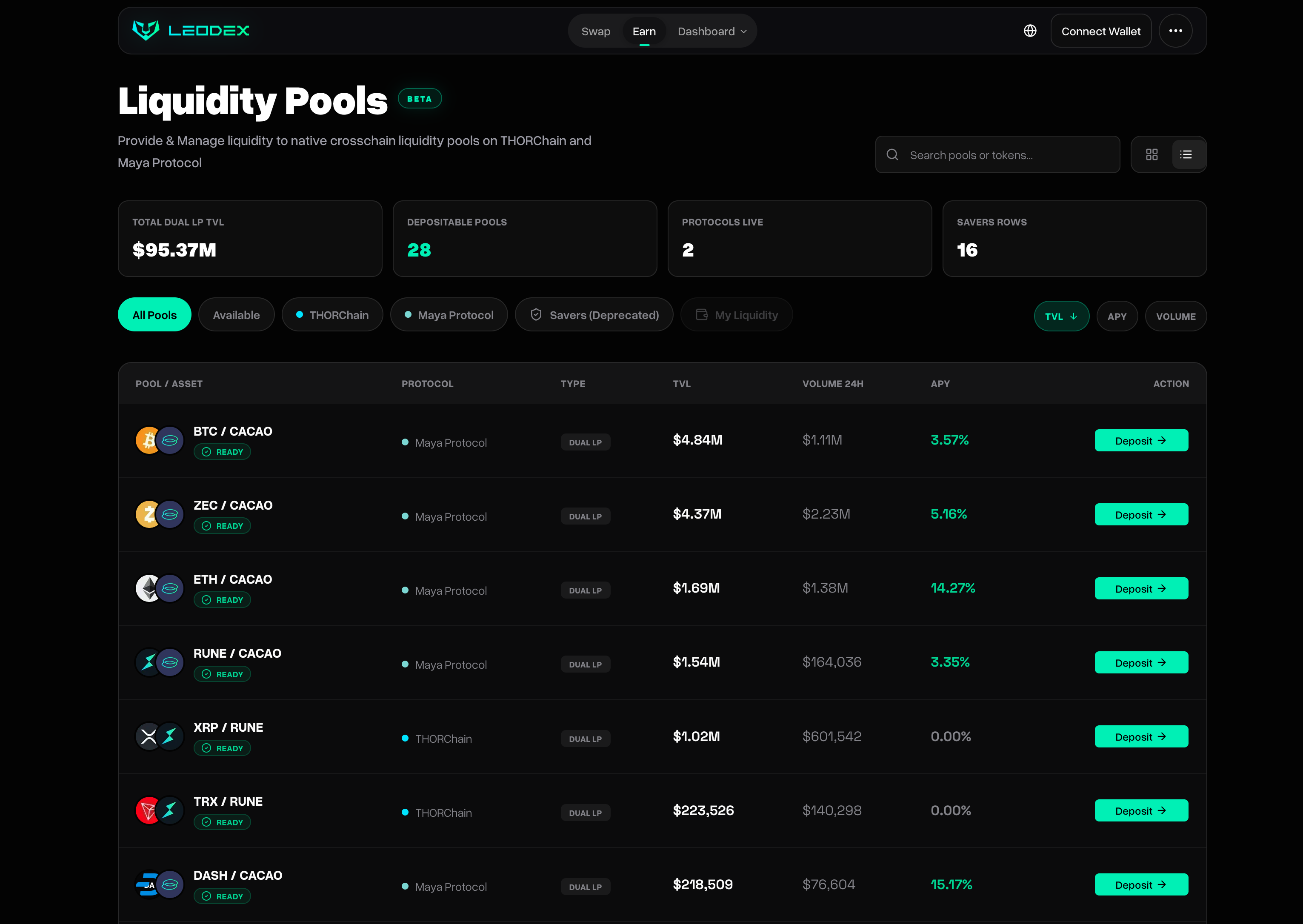
Read across any row: the asset and the paired token (BTC / CACAO), the protocol, the pool type (DUAL LP for active Maya pools, since Maya doesn't expose Savers in /earn beta), the TVL, the trailing 24-hour volume, the current APY, and a green Deposit button.41 For the rest of this guide we click the Maya Protocol pill, which narrows the table to the live Maya CACAO-paired pools.
A few of those numbers are worth pausing on. Total Dual LP TVL: $95.37M across both protocols on /earn. Maya's slice of that, summed from the visible Maya pools at the top of the screenshot (BTC $4.84M, ZEC $4.37M, ETH $1.69M, RUNE $1.54M, DASH $218K) plus the Maya pools below the fold (MOCA, MAYA, the Arbitrum-side ETH and stablecoin pools) is roughly $12–13M, which lines up with DefiLlama's tracked Maya TVL of about $15M when you include the chains the dashboard rolls up but doesn't list separately.20 By DefiLlama's bridge-category rank, Maya sits at #7. By cross-chain LP retail accessibility, it's a category of three — Maya, THORChain, Chainflip — and only Maya and THORChain run the dual-asset native-LP model.2234
The Beta pill next to the page title is doing real work. Hover it and you'll see "Liquidity pools and the Earn page are in open beta. This feature launched on May 6, 2026. Please use your own discretion and report feedback to the LEO team." That is not marketing copy. Beta means we may iterate on position math and position-tracking edge cases. Treat the dashboard as a high-quality deposit and management tool, but verify your position on MayaScan before exiting any large position.19
§ 03 Maya 101The architecture in five paragraphs
Maya Protocol is a Cosmos-SDK Layer-1 blockchain that operates as a non-custodial cross-chain DEX. It uses Tendermint BFT consensus (instant finality, two-thirds supermajority), GG20 threshold-signature scheme vaults across an active validator set of thirty-eight nodes (live count, May 2026), and a chain-agnostic message-passing layer called Bifrost that observes deposits and signs withdrawals on Bitcoin, Ethereum, Arbitrum, THORChain, Dash, and Zcash.011117 No node ever holds a complete private key for the vaults. No party — including the Maya Foundation itself — has the unilateral authority to move user funds.
Maya is a friendly, code-level fork of THORChain with mainnet genesis in March 2023 and trading going live on April 20, 2023.0223 The two protocols share the same DNA — Continuous Liquidity Pools, slip-based fees, threshold-signed Asgard vaults, native asset settlement (no wrapped tokens, no IOU custody) — but diverge in five meaningful ways: Maya kept Impermanent Loss Protection while THORChain killed it; Maya validators bond LP units (Liquidity Bond) rather than pure CACAO (Pure Bond); Maya supports DASH, KUJI, and ZEC natively while THORChain doesn't; Maya has zero VC and zero team CACAO allocation while THORChain IDO'd RUNE; and Maya runs ~38 validators while THORChain runs ~100.22 The Maya team frames the protocols as complementary, not competitive: "an airplane can fly with one engine, but two engines make it more resilient."
The protocol uses two tokens. CACAO is the working asset — fixed 100,000,000 supply minted at genesis, no inflation, paired against every external asset in every pool, used for gas, bonded by validators.05 Maya targets a deterministic floor where CACAO market cap ≥ external Asset TVL: "if $1,000,000 worth of non-Cacao tokens are staked in Maya Protocol, the market cap of CACAO will be at least $1,000,000."05 At the time of writing CACAO trades around $0.139 with a market cap near $13M — roughly 91% below its all-time high of $1.43 set in December 2024.21 That drawdown is the dominant LP risk factor right now and we'll come back to it in §10.
MAYA is a separate token with a fixed supply of exactly 1,000,000 — one million, not one hundred million. (The supply gets miscited routinely; verify directly on Maya's whitepaper.06) MAYA captures 10% of all protocol revenue and distributes it daily as CACAO to MAYA holders, pro-rata.27 So for every $9 a Maya LP earns from swap fees, MAYA holders collectively earn $1. MAYA is not pooled, not formally traded on Maya itself, and 78% of the supply went to a Dev Fund at genesis — but founder allocations are permanently non-transferable, meaning founders only ever realise yield from accrued CACAO dividends, never from selling MAYA principal.06 It's a more honest team-incentive structure than 99% of crypto.
Finally, the launch model. Maya was distributed via a 21-day Liquidity Auction in March 2023 with no whitelist, no minimum, no maximum, no discounted private sale, and no team allocation of CACAO.31 Ninety percent of the 100M CACAO supply went pro-rata to LPs based on their share of total auction value contributed; ten percent went to the Impermanent Loss Protection treasury. "There was zero $CACAO allocation for the team, seed investors, venture capital, or the like," Maya's documentation states plainly. This is one of the most ideologically pure fair launches in DeFi history. Whether you weight that or not, it's a feature of the protocol's history that deserves to be on the table when you're deciding whether to deposit.
§ 04 How pools actually workThe mechanics, with the math you actually need
Every Maya pool is a 50/50 USD-value Continuous Liquidity Pool — one external asset on one side, CACAO on the other, balanced at deposit time so each side carries equal dollar value. The protocol uses the standard constant-product invariant:
X · Y = K
Where X is the CACAO depth and Y is the external asset depth. A swap of input x from one side produces an output y on the other side, computed against this invariant.03
Slip-based fees. Where Maya genuinely diverges from Uniswap v2 is the fee model. Uniswap charges a flat 0.30% on every trade regardless of size. Maya charges a fee proportional to how much the trade displaces the pool — a quantity called slip:
slip = x / (x + X)
fee = (x² · Y) / (x + X)²
A trade that consumes 1% of the pool's depth incurs ~1% slip and pays ~1% fee. A trade that consumes 10% of depth incurs ~9% slip and pays ~9% fee. The fee structure scales quadratically with input size relative to pool depth, which means small retail swaps pay far less than Uniswap's fixed 0.3%, while large depth-distorting trades pay materially more.03 Per Maya's whitepaper: "The fee paid is commensurate to the demand of the pool's liquidity." This is not a tax — it's a sandwich-attack defense. The more aggressively a trader (or attacker) demands liquidity from the pool, the more they pay. That fee accrues to LPs.
LP units. When you deposit, you don't receive a wrapped LP token (Maya doesn't have those). Instead, the protocol records liquidity units against your address, computed as a fraction of total pool ownership. The exact formula:
units = P × (rA + Ra + 2ra) / (rA + Ra + 2RA)
Where P is total pool units pre-deposit, r/a is the CACAO/asset you're depositing, and R/A is the pre-deposit pool depth on each side.03 If you own 0.5% of total pool units, you receive 0.5% of all swap fees and emissions. When you withdraw, you receive 0.5% of the pool's current asset and CACAO depth, which will have grown via fee accrual but may have shifted in composition due to swaps. That composition shift is impermanent loss — we'll cover it in §09.
Why every pool requires CACAO. This is the most common point of confusion for newcomers. You can't pool BTC against ETH directly on Maya. You pool BTC against CACAO, or ETH against CACAO, and the protocol routes BTC↔ETH swaps through CACAO as the intermediate hop. This is exactly why CACAO is required: it's the common-denominator settlement asset that makes any-to-any swap routing possible with only N pools instead of N². Whatever asset you want to provide liquidity in, you need an equal USD value of CACAO to pair against it.05
Symmetric vs. asymmetric. Maya at the protocol level supports both symmetric deposits (you provide equal USD values of asset + CACAO; no slip cost) and asymmetric deposits (you provide only one side; the protocol does an internal swap to balance). On leodex.io/earn in beta, we currently expose only the symmetric path: enter the asset amount, the CACAO pairing is calculated and locked at the current pool ratio, and you sign two transactions — one on the asset's chain, one on MAYAChain.08 If you want pure asymmetric single-asset deposit you can do it via custom memo through AsgardEx or another power-user tool, but for almost all users the symmetric path on /earn is what you want. (One useful editorial nuance: per Maya's own docs, "there is no difference between swapping into symmetrical shares, then depositing that, or depositing asymmetrically and being arb'd to be symmetrical."04 The asymmetric path costs slip on the half-swap inside the deposit; symmetric costs slip on whatever swap you did manually first to acquire CACAO. Net cost is approximately the same.)
§ 05 Step-by-step: adding liquidity via /earnFrom wallet connect to broadcast confirmation
The full deposit flow is six clicks plus two wallet signatures. Walk through it with me.
Step 1: Connect your wallets
You need wallets connected to (a) the chain of the asset you're depositing, and (b) MAYAChain itself for the CACAO leg. For an ETH/CACAO deposit, that means an EVM wallet (MetaMask, Ctrl, Ledger via MetaMask) plus a Cosmos-compatible wallet for MAYA (Keplr, Leap, or the same Ledger via the Cosmos app at derivation path m/44'/118'/0'/0/0).15 For BTC/CACAO, a Bitcoin wallet (Vultisig or hardware) plus the MAYA wallet. For institutional-size positions Vultisig's TSS architecture is recommended — no seed phrase to compromise.44 Smart-contract wallets like Safe (Gnosis), Argent, or any account-abstraction wallet are NOT supported on Maya's ETH Router — deposits from contract addresses are silently ignored, which means funds could vanish without recourse. This warning is buried in Maya's protocol docs and almost no third-party guide surfaces it.15
Step 2: Filter the dashboard to Maya Protocol
Click the green Maya Protocol pill below the stats. The table narrows to live Maya CACAO-paired pools, sorted by TVL descending by default. (Click the APY sort button if you'd rather rank by yield.) The top of the table on the day this guide was written: BTC ($4.84M depth, 3.57% APY), ZEC ($4.37M, 5.16%), ETH ($1.69M, 14.27%), RUNE ($1.54M, 3.35%), DASH ($218K, 15.17%) — verified against Maya's Midgard API at the same moment as the screenshots.16
Step 3: Pick a pool
The selection criteria are not just "highest APY." A higher APY usually reflects either smaller depth (more fee per dollar of LP capital, but more impermanent-loss sensitivity) or more volatile external asset price (which generates more swap volume but more IL risk). The cleanest selection rules:
- Pool the asset you already hold. Don't swap into DASH just to chase 15.17% — the swap-in slip will eat the yield differential.
- Prefer deeper pools for larger positions. A $50,000 deposit into a $200,000-depth pool moves the price ratio materially and degrades both your effective entry and your IL profile.
- Read the 24h volume column. Volume relative to depth tells you how much fee revenue is being generated. ZEC at $2.25M / $4.43M = ~50% daily turnover is generating meaningful fees per dollar of LP. MOCA at $0 / $221K is generating nothing.
- Match your risk tolerance. ETH has volatility you understand. DASH has volatility plus a thinner secondary market. ZEC has volatility plus a 670% YoY move in 2025-2026 that may or may not continue.
Step 4: Open the pool, read the Overview tab
Click Deposit on your chosen pool. The action dialog opens on the Overview tab by default if the pool is Available. The green "Live Action Gates Open" banner means Maya's pool, inbound, and Mimir checks all pass — deposits are currently permitted. If you see an amber "Live Action Gates Need Review" banner, the dialog will list which Mimir flag is blocking deposits (chain halt, chain-specific LP pause, pool unavailable) and you should not deposit until the gate clears.10
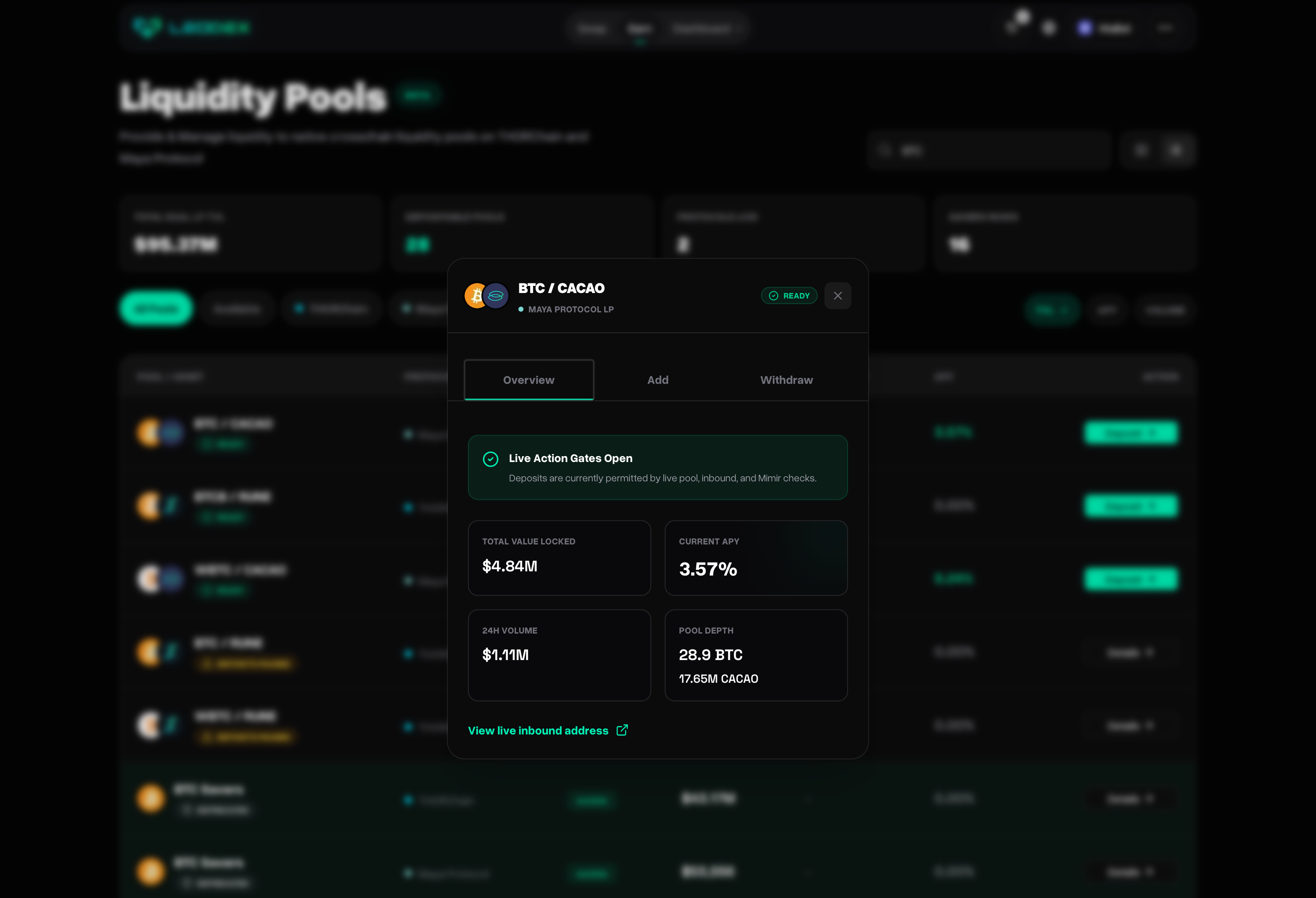
The four stat cards are the data points that actually matter for sizing your deposit:
- Total Value Locked — total USD value of both sides combined. Larger TVL = more depth = less slip per dollar of deposit.
- Current APY — extrapolated from the past 30 days of LUVI growth (more on this in §06). 3.57% on BTC means LPs earned ~0.3% in fees over the past month, annualised.
- 24H Volume — fee-generating activity. The ratio of volume to TVL is your real yield signal.
- Pool Depth — exact asset and CACAO quantities in the pool. For BTC/CACAO at the time of the screenshot: 28.9 BTC and 17.65M CACAO. Use this to compute exactly how much of the pool your deposit will own.
Step 5: Click Add and enter your asset amount
Switch to the Add tab. Type your asset amount in the top input box — for example, 0.10 BTC. The bottom box (Required Pairing) immediately calculates the CACAO amount needed at the current pool ratio and locks it. You don't enter the CACAO amount; the protocol does, because the deposit must hit the pool in-ratio to avoid causing slip on yourself.
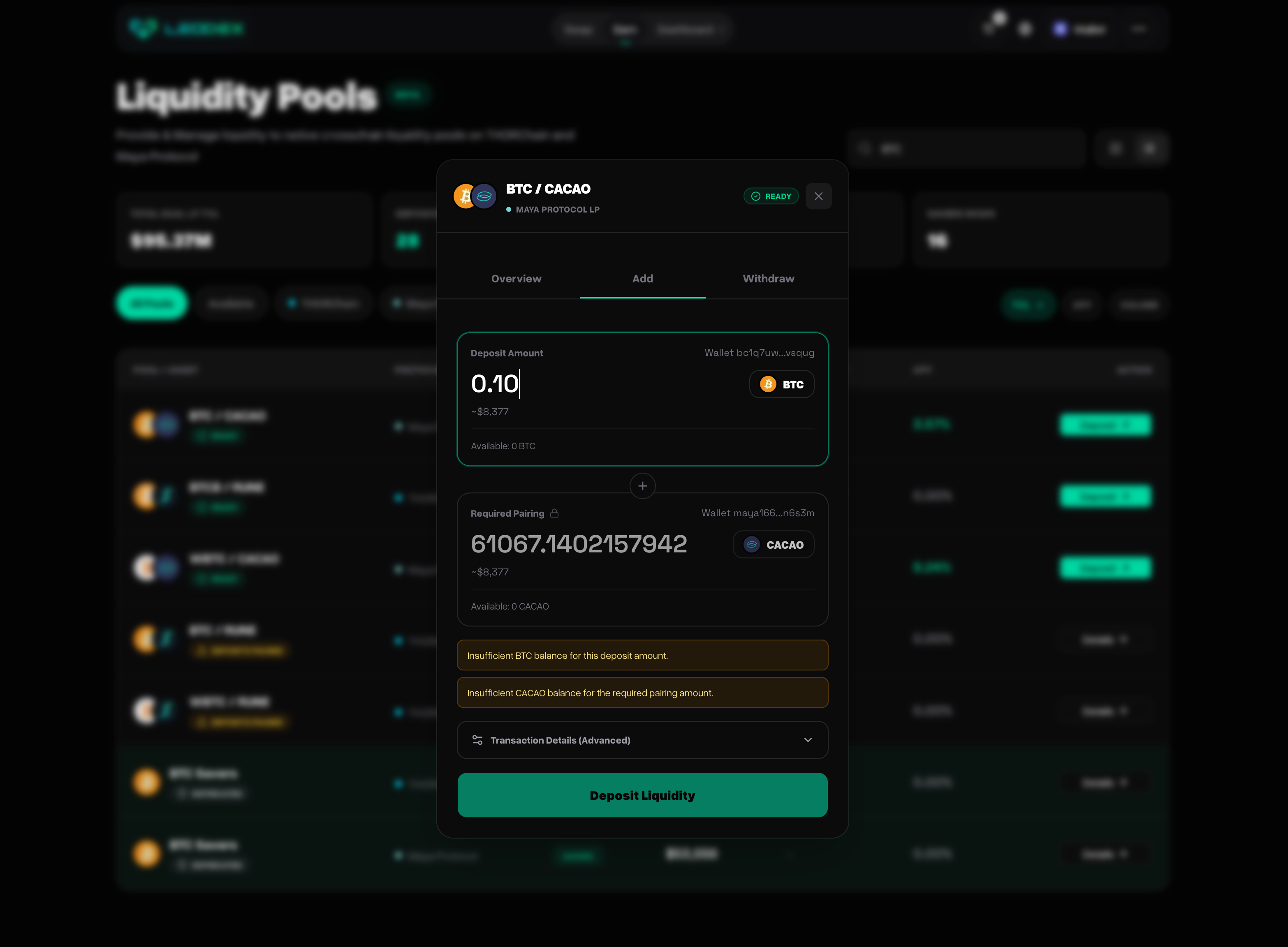
A few things to note from the screenshot. The USD equivalent below each amount makes it easy to verify you're depositing equal value on both sides — both legs show ~$8,377. The wallet addresses are truncated above each input (BTC bc1q7uw…vsqug, MAYA maya166…n6s3m) so you can verify which wallet each leg is coming from. The amber warnings are the UI correctly catching that the example wallet doesn't actually hold enough on either side — fix this in real life by either funding the wallet or reducing the deposit amount.
The Transaction Details (Advanced) accordion at the bottom is worth opening if you want to see exactly what the protocol-level memo and inbound address will be for each leg. This is also where the affiliate fee shows up — currently 25 BPS, which is what funds LeoDex's continued development. Critics of affiliate fees on aggregator UIs aren't wrong that direct-to-protocol via AsgardEx pays nothing; the trade-off is clean web UX, integrated wallet stack, and ongoing maintenance.
Step 6: Sign the asset leg, then sign the CACAO leg
Click Deposit Liquidity. The dialog walks you through two transactions in sequence:
- Asset leg — for ERC-20 assets (USDT, USDC, MOCA), this is an "Approve + Deposit" pattern through Maya's ETH Router using
depositWithExpiry. For native chains (BTC, ETH, DASH, ZEC), it's a single transaction with the Maya memo encoded in OP_RETURN or equivalent. Sign it in your asset-chain wallet. - CACAO leg — a
MsgDepositon MAYAChain itself, sending the calculated CACAO amount with a memo that includes the asset-chain address as the pair link. Sign it in your MAYAChain wallet.
Both legs need to land within the same churn window (~5 days) for the protocol to match them into a single dual-LP position. In practice this is irrelevant unless you intentionally space them out — under normal use, you'll sign both within a few minutes. Once both are observed, your position appears in the My Liquidity tab and starts earning swap fees on the next block.
§ 06 Yield: what you actually earnWhere the APY comes from and what to expect
Maya LP yield is composed of three streams: slip-based swap fees, block-reward emissions, and (for bonded LPs only) Liquidity Node bond rewards.04 No external token incentives. No third-party emissions. No mercenary farming. The yield is purely organic.
Slip-based swap fees are the dominant component on active pools. Every swap retains a portion of slip on the output side; LPs earn pro rata to their unit ownership. This is why higher-volume pools pay more — fees are a function of slip × volume, not a fixed percentage.
Block-reward emissions are paid out of Maya's reserve. Per-block reward distribution rules:
- If a block contains swaps, that block's pool reward share is allocated proportional to fees collected per pool.
- If a block has no swaps, that block's reward share is allocated proportional to pool depth.
This means deeper pools earn the floor of "no-volume idle yield"; higher-volume pools earn proportionally more during active blocks.03
Compounding is per-block, with Maya blocks at roughly 6 seconds, so APR and APY diverge meaningfully. Maya calculates pool yield via the Liquidity Unit Value Index:
LUVI = √(AssetDepth × CacaoDepth) / PoolUnits
APR is then extrapolated as a 30-day rolling annualisation of the LUVI delta. The Midgard /v2/pools/{asset} endpoint exposes annualPercentageRate and poolAPY directly — these are the numbers /earn displays.2616
- DASH / CACAO
- 15.17% APY · TVL $218K · Vol 24h $77K
- ETH / CACAO (mainnet)
- 14.27% APY · TVL $1.69M · Vol 24h $1.38M
- ARB.ETH / CACAO
- 10.30% APY · TVL $143K · Vol 24h $10K
- ARB.WBTC / CACAO
- 9.24% APY (verified Midgard)
- ZEC / CACAO
- 5.16% APY · TVL $4.37M · Vol 24h $2.23M (highest 24h volume)
- BTC / CACAO
- 3.57% APY · TVL $4.84M · Vol 24h $1.11M
- THOR.RUNE / CACAO
- 3.35% APY · TVL $1.54M · Vol 24h $164K
- ETH.MOCA / CACAO
- 2.36% APY · TVL $221K · Vol 24h $0
- ETH.USDC / CACAO
- 2.07% APY (verified Midgard)
- MAYA.MAYA / CACAO
- 0.99% APY (illiquid; not for retail LP)
How does this stack against alternatives? A few honest comparisons:
- vs. Coinbase staking: Coinbase ETH staking pays ~3% (after their 35% commission). Maya ETH/CACAO pays 14.27% but carries IL risk and 50% CACAO exposure. Risk-adjusted, the comparison depends on your view of CACAO.
- vs. Curve 3pool: Curve stable pools pay 3-10% with near-zero IL risk on stables but require USDC/USDT custody on Ethereum. Maya BTC/CACAO at 3.57% is roughly Curve-equivalent yield but on real, unwrapped, native BTC — that's the trade.
- vs. Uniswap V3 concentrated liquidity: V3 LPs can pay 5-15% on USDC/USDT pairs if actively range-managed, or 8-40% on volatile pairs. But 67% of V3 LPs in volatile pairs are underwater vs. HODL when range-management is imperfect. Maya's full-curve passive model removes the range-management failure mode at the cost of lower headline yield.
- vs. MEXC USDT savings: MEXC's 4-8% standard, up-to-300%-promo USDT yield is gross. Net of (a) custody risk, (b) the possibility of your account getting frozen for "abnormal trading" with no appeal, and (c) MEXC's parent entity being a dissolved Seychelles shell with no serviceable legal address — the risk-adjusted return is hard to take seriously. See our prior editorial on MEXC for the full picture.
The MAYA token as alternative yield exposure. If you're attracted to Maya's economics but don't want to actively manage an LP position, the MAYA token is an equity-like claim on protocol revenue: 10% of all protocol fees flow to MAYA holders daily as CACAO, distributed pro-rata across the 1M fixed supply.27 Be honest about current yield: at the trailing 30-day average activity (~$342/day in protocol fees), the MAYA holder share is ~$34/day across the entire 1M supply, which works out to about 0.23% APY at MAYA's current ~$4.42 implied price. The pitch isn't current cashflow — it's holding a fixed-supply revenue claim that captures upside if Maya's volume grows.
§ 07 Withdrawing your positionThree modes, one slider, one critical rule
Open the same pool's action dialog, switch to the Withdraw tab, and you get a percentage slider, four preset buttons (25/50/75/Max), and a Withdraw As segmented control with three options: Dual, asset-only, or CACAO-only.
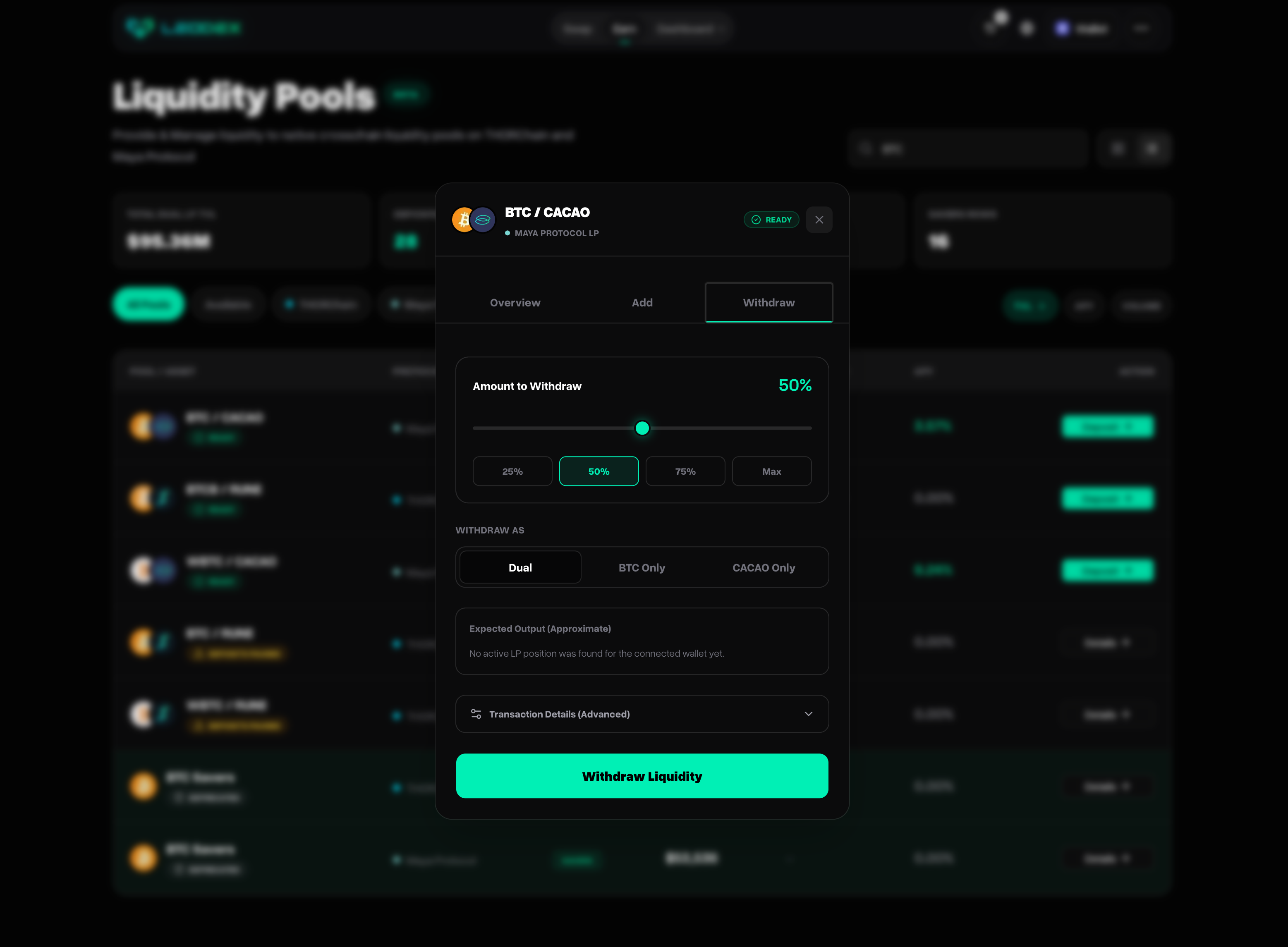
The three withdrawal modes are not just convenience — they solve a real LP problem:
- Dual: receive both assets pro-rata to your LP share. This is the cleanest exit — you simply unwind back to the assets you started with.
- Asset only (e.g. BTC Only): receive only BTC. Maya internally swaps the CACAO half of your position into BTC before paying out. Slip is charged on the half-swap. Useful if you want clean asset exposure and don't want to hold CACAO post-exit.
- CACAO only: the inverse — receive only CACAO, with the asset half swapped to CACAO before payout. Useful if you're rotating between Maya pools and want to redeploy into a different asset's pool.
Behind the scenes, Maya executes withdrawals via a memo of the form WD:POOL:BASISPOINTS:OPTIONAL_SIDE sent from either your asset wallet or your MAYA wallet — a "trigger transaction" carrying the memo, with the actual withdrawal value coming from your locked LP position.09 50% as a percentage becomes 5,000 basis points; 100% becomes 10,000. The advanced accordion shows the full memo if you want to verify exactly what's being broadcast.
The one critical rule everyone gets wrong. If you deposited symmetrically (which is what /earn does), you can withdraw in any of the three modes — Dual, asset-only, or CACAO-only. But if you deposited asymmetrically (single-asset, via custom memo through AsgardEx or similar), you can only withdraw on the same side you deposited from. An asset-only depositor can't withdraw to CACAO. A CACAO-only depositor can't withdraw to the asset.09 This is the most common point of confusion in Maya support channels — readers running asymmetric deposits via power-user tools should understand the constraint before depositing. For /earn users, this never matters because we always deposit symmetrically.
§ 08 Tracking and managing your positionThe My Liquidity view
Once both deposit legs are observed, your position appears in the My Liquidity tab on /earn. Click the My Liquidity filter pill (visible only when your wallet's connected) and the table swaps to show only pools where you have an active position.
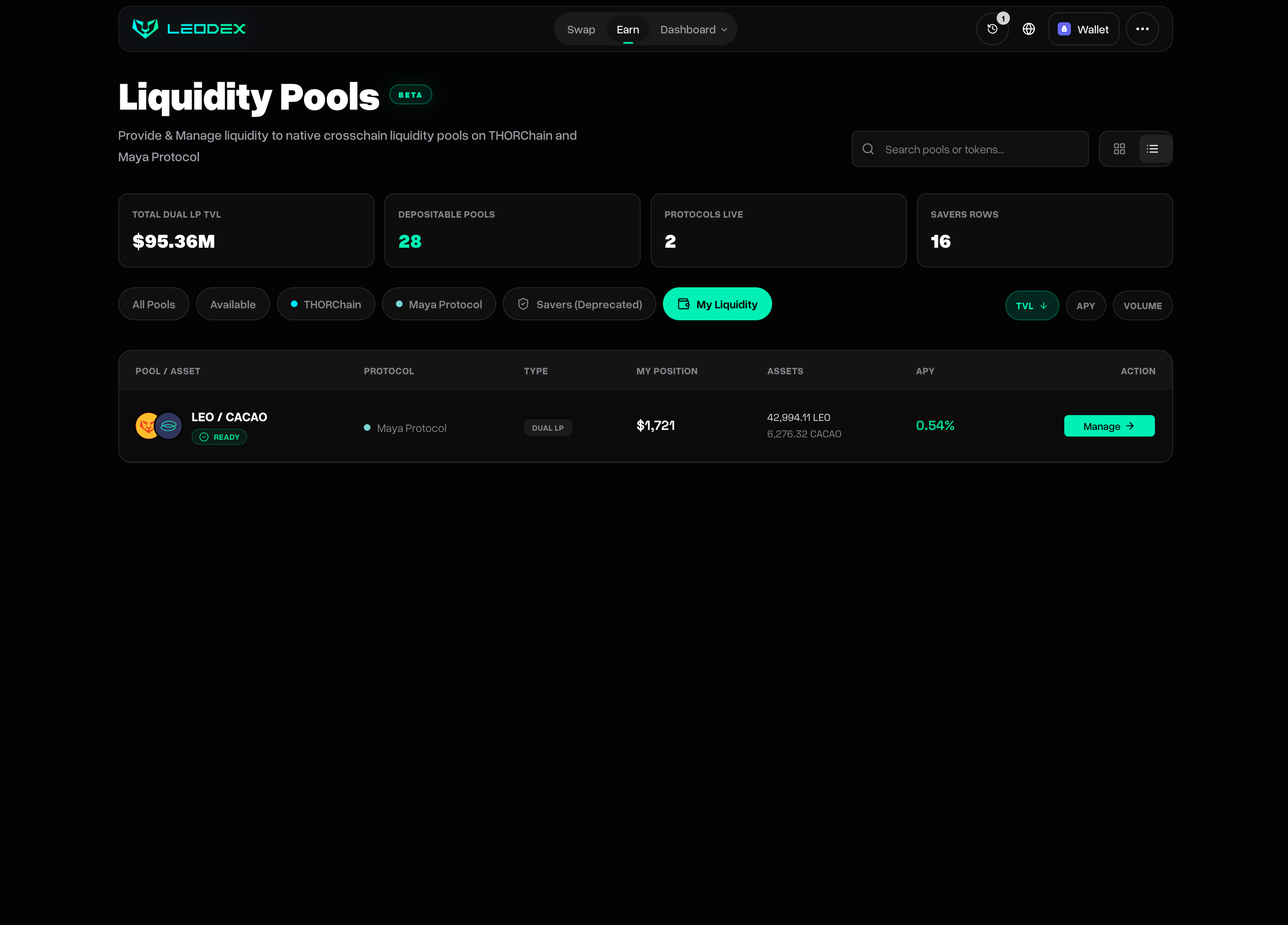
The My Liquidity columns swap from the default view: instead of TVL and 24h Volume, you see My Position (the current USD value of your LP units) and Assets (the underlying asset and CACAO amounts at current pool ratio). The Action button changes from Deposit to Manage, which opens the action dialog with the Withdraw tab pre-selected so you can immediately exit if you want.
Position value updates every block. Your asset amount may drift higher or lower than your initial deposit as swaps move the pool ratio (this is the surface mechanic of impermanent loss, covered in §09). Your liquidity-unit count itself never changes unless you explicitly add or withdraw.
For deeper analytics — historical fee accrual, exact unit count, ILP eligibility tracking — open the live inbound address link from the Overview tab and cross-reference your wallet on MayaScan. MayaScan exposes per-position fee history and the exact LP-unit math, which is what you'll want before exiting any large position.19
§ 09 Impermanent Loss ProtectionThe Maya advantage THORChain killed
Impermanent loss is what happens when the price ratio of the two assets in your pool diverges from the ratio at deposit. If you deposit $1,000 of BTC + $1,000 of CACAO and BTC then doubles relative to CACAO, the AMM rebalances by selling some of your BTC into the pool — your position ends up holding less BTC than you deposited, with the difference offset by more CACAO. If you'd just held both assets in a wallet, you'd have done better. The gap is the "loss," and it's "impermanent" only in the sense that it reverses if the price ratio returns to baseline — which it usually doesn't.
The exact IL formula on a 50/50 pool:
IL = 2·√(price_ratio) / (1 + price_ratio) − 1
Where price_ratio is the new price of the asset relative to CACAO divided by the deposit price. The function is symmetric: a 2× move and a 0.5× move both produce 5.7% IL. The worst-case selected values (memorise these):
- Asset moves 1.25× vs CACAO (or CACAO moves 1.25× vs asset)
- 0.6% IL
- 1.5×
- 2.0% IL
- 2× (or 0.5×)
- 5.7% IL
- 3× (or 0.33×)
- 13.4% IL
- 4× (or 0.25×)
- 20.0% IL
- 5× (or 0.2×)
- 25.5% IL
Now the differentiator. THORChain originally shipped Impermanent Loss Protection in 2021: an LP-protection scheme where the protocol's reserve covered IL out of pocket on a 100-day ramp, capped at 100%. THORChain deprecated it in November 2023 via ADR-005, citing it as "an outstanding, potentially unbounded liability to the protocol."32 Maya kept ILP. The current schedule:07
- Coverage starts on day 50 after your deposit. Withdraw before day 50 and you receive zero ILP.
- Coverage caps at 100% of impermanent loss.
- Asymmetric daily accrual: if the external asset outperforms CACAO, you accrue 1% coverage per day, reaching 100% at day 150. If CACAO outperforms the asset, you accrue 0.25% per day, reaching 100% at day 450.
- Top-ups (adding more liquidity to an existing position) reset the 50-day clock.
- Partial withdrawals don't trigger payout and don't reset the clock.
- Full withdrawal triggers payout and resets.
- If accumulated swap fees already cover your IL, no ILP is paid — ILP only fills the gap.
The funding source: 10% of CACAO's genesis supply (10M CACAO) was allocated to the IL Protection treasury at launch, plus 10% of ongoing protocol fees flow into the same reserve. As of the time of writing, ~7,595,316 CACAO (~$1.05M USD) of ILP has been paid out to LPs across Maya's history.07
ILP guarantees that LPs will either make a profit or at least recoup their investment (in USD value) in comparison to holding them externally after a certain period.— Maya Protocol Documentation, ILP
The honest caveat. Maya's docs are explicit: "ILP does not protect you from both assets depreciating. This loss would occur if you were just holding the assets in your wallet anyway."07 The protection is structurally a hedge against price divergence between the two pool sides, not a general loss-protection wrapper. If CACAO falls 30% and BTC also falls 30%, you lose 30% — ILP doesn't cover it because there's no impermanent-loss component, just a directional drawdown.
Practical implications for an LP planning their position:
- Hold for at least 50 days minimum, ideally 150+. Pre-50, you have no protection. Sub-150, you have partial. After 150 (asset-outperforms case), you're fully covered.
- Don't top up a maturing position. Adding liquidity resets your ILP clock to zero. If you want to add, do it as a separate position from a separate wallet pairing if possible.
- Plan for the both-assets-fall scenario. ILP doesn't save you from a generalised crypto downturn. Size your LP positions accordingly.
§ 10 Risk, honestlyWhat can go wrong and what can't
I want to be useful here, not promotional. Here's the risk surface in honest order, biggest first.
1. CACAO drawdown
CACAO at $0.139 today is roughly 91% below its all-time high of $1.43 set in December 2024.21 Market cap ~$13M. Every Maya LP carries 50% CACAO exposure, including single-sided depositors (Maya internally balances any deposit into 50/50 before computing IL). This means: even if you nail your pool selection and timing, your LP value tracks 50% of CACAO's market price. A CACAO-priced 50% drawdown over a year is not unusual. ILP offsets this if the external asset moves opposite CACAO, but not if both fall together.
If your view on CACAO is bullish or neutral, this is a feature, not a bug — you're getting paid yield to hold an asset you'd hold anyway. If your view on CACAO is bearish, don't LP. Hold the external asset directly, or look at non-Maya alternatives.
2. Impermanent Loss Protection has limits
Covered in §09. ILP covers divergence; it doesn't cover joint drawdown. The 50-day cliff means short-duration LPs get nothing. Top-ups reset the clock.
3. Smart contract surface
For ETH-side and Arbitrum-side LPs, the relevant surface is Maya's ETH Router contract. The Halborn audit of this contract is still labeled "Draft 3" on Maya's own audits page as of May 2026.1449 The architectural primitive is similar to THORChain's, which was exploited twice in July 2021 for a combined ~$15M (refund-logic and msg.value-forging vulnerabilities in the Bifrost interface, not the Cosmos-SDK chain itself).35 Maya itself has had no documented loss-of-funds exploit since mainnet launch in April 2023, but the inherited architecture warrants honest disclosure.
Also: do not deposit through smart-contract wallets. Maya's ETH Router silently ignores deposits from contract addresses (Safe/Gnosis, Argent, AA wallets). Funds sent that way may be unrecoverable.15
4. Validator and TSS risk
Maya's 38 active validator nodes jointly custody all external-chain funds via GG20 threshold-signature scheme. No node holds a complete private key. Compromise requires colluding 2/3+ of the active set within a single churn window (~5 days). The risk is real but well-mitigated: validators bond LP units worth more than the funds they protect, and any unauthorised transaction triggers automatic bond slashing at 1.5× the mishandled amount.13
Operational halts have happened on Maya without loss of funds: Dash chain client halts, Kujira launch issues, ETH halts during v116 rollout, RUNE halts to align with THORChain v3 hard fork. None of these cost users money, but they did suspend deposits and withdrawals on affected pools temporarily. Always verify the live gate status on the pool's Overview tab before depositing.
5. Token impostor risk
There are at least three impostor tokens that get confused with Maya:
- "MAYA" on MEXC and Bybit is a Solana memecoin priced at fractions of a cent. NOT Maya Protocol's revenue token. The real MAYA is OTC-only via official Discord.
- A fake BEP-20 CACAO at
0x0d8d0e7aa4860988c0993e0a16c50338e67c55f0on BNB Chain impersonates real CACAO. Real CACAO lives only on MAYAChain itself. - maya.ph is a Philippine fintech bank, completely unrelated. If you're on a domain other than mayaprotocol.com, mayachain.info, or your own LeoDex/AsgardEx/THORWallet/Edge interface, double-check.
6. Tax considerations
Not legal or tax advice; consult a CPA who handles crypto. The IRS has issued no specific guidance on LP deposits as of May 2026. Practitioners take one of two approaches: (a) conservative — each LP deposit is a taxable disposal of the deposited assets in exchange for an LP unit, with cost basis resetting; (b) aggressive — LP deposit is a non-taxable technical step, no disposal until you actually sell. Either approach is defensible, but the audit trigger is inconsistency. Pick one, apply it consistently year-over-year, document everything: deposit txid, exit txid, on-chain block, fair market value at each event.
7. Bug bounty caps are small
Maya's Immunefi Critical bounty is capped at $35,000.48 That's small relative to the ~$15M+ the protocol custodies across chains. THORChain-inherited issues are explicitly out of scope ("if it's related to THORChain in any way, it's out of scope for the program") — meaning whitehats reporting Maya-side recurrences of THORChain-class bugs receive nothing. Both are honest credibility flags worth disclosing.
§ 11 Maya vs. the restWhy someone would actually choose this
Cross-chain native-asset LP is a category of three live protocols: Maya, THORChain, and Chainflip. Composable Finance attempted it and largely abandoned the LP angle. Sifchain shut down. ZetaChain has cross-chain primitives but limited true-LP product.22 The full universe of "places where retail can passively LP cross-chain native unwrapped BTC" is essentially Maya and THORChain — and only Maya has Impermanent Loss Protection still active.
- Maya Protocol
- Native CLPs paired vs CACAO. ILP active. ~$15M TVL. 18 pools. Fair launch 2023.
- THORChain
- Native CLPs paired vs RUNE. ILP deprecated 2023. Savers deprecated for new deposits Jan 2025. Larger TVL.
- Chainflip
- USDC-paired JIT AMM. Pro market makers dominate; retail LP is theoretical. Tighter spreads, no ILP.
- Composable / Mosaic
- Largely abandoned LP product.
- NEAR Intents
- Solver-network model. NO retail LP path. Different category.
Within that comparison, the strongest reasons to choose Maya specifically:
- You want ILP coverage. Maya has it. THORChain doesn't. Chainflip doesn't.
- You hold DASH, KUJI, or ZEC. Maya is the only decentralised cross-chain venue for these. Nowhere else in DeFi can you LP native unwrapped DASH or KUJI.
- You want passive yield, not active range management. Maya's full-curve CLPs require zero rebalancing. Chainflip's concentrated-range model is great if you want to actively manage; painful if you don't.
- You value the fair-launch ethos. Maya has zero VC and zero team CACAO. You and the founders got CACAO at the same auction price. THORChain IDO'd RUNE.
- You're a former THORChain Savers user looking for the closest equivalent product post-deprecation. Maya dual-LP is it — different risk profile (50% CACAO exposure vs Savers' single-sided) but the only cross-chain native yield product still accepting deposits.
The strongest reasons to not choose Maya:
- You're bearish CACAO. 50% CACAO exposure is a feature for the bullish/neutral; a tax for the bearish.
- You need stable-coin yield. Curve and Aave do this better. Maya's USDC pool has thin depth and yield comes from the same slip-fee mechanics that work better on volatile pairs.
- You're depositing seven figures. Maya's pools are deep enough for retail and small-institutional but not for whale-scale. A $1M deposit into a $5M-depth pool will move the ratio noticeably and degrade your entry.
§ 12 Frequently askedQuestions readers actually search for
Most of these are also answered in the structured FAQ above; this section adds the operational nuance that can't fit in a 60-word snippet.
"My deposit went through but my position isn't showing in My Liquidity"
Both legs need to land within the same churn window (~5 days) and the protocol matches them based on the paired-address memo. Most commonly this is just a block-confirmation delay (Bitcoin in particular needs ~6 confirmations before Bifrost observes the deposit). Wait 30 minutes, refresh. If the position still doesn't appear after an hour, check both txns on MayaScan to confirm observation, and verify your memo formatting if you used a custom tool.
"Can I LP without holding CACAO?"
Not really. You can do an asymmetric (single-sided) deposit through AsgardEx or a custom memo, where Maya does an internal swap of half your asset into CACAO before pooling. But you can't escape the 50% CACAO exposure of the resulting position — it's structural to the 50/50 CLP model. If you genuinely don't want CACAO exposure, Maya isn't the right venue. Look at Chainflip (USDC-paired) or single-asset lending products elsewhere.
"What's the 0.10 BTC required pairing of 61,067 CACAO actually about?"
That's the screenshot example: 0.10 BTC at ~$83,770/BTC = ~$8,377. At CACAO ~$0.137, $8,377 of CACAO = 61,067 CACAO. The protocol calculates the pairing at the current pool ratio, which is approximately the current USD-to-USD equality but adjusts slightly based on actual pool depth at the moment of deposit. The locked pairing prevents you from depositing out-of-ratio (which would cause slip on yourself).
"How do I track my IL and ILP eligibility?"
Beyond the My Liquidity tab, the cleanest source is MayaScan's pool-position page. It shows your initial deposit, current redeemable value, days elapsed since last deposit, and accrued ILP eligibility. ILP only pays at full withdrawal — so the displayed coverage is what you'd get if you exited today.19
"What if Maya gets hacked?"
Maya has not been hacked since mainnet launch in April 2023. If it were, you'd see (a) the protocol's solvency checker auto-halt the affected chain at 66%+ node consensus, (b) Mimir flags pause LP additions/withdrawals, and (c) Maya Discord and Twitter would announce. The protocol's design favours conservative response — halt first, audit, patch, resume. Treasury bailouts (THORChain ate $16M of Chaosnet-era exploit losses) are not a guarantee on Maya; the post-mainnet stance, like THORChain's after Q1 2022, is that loss events are shared with network participants per protocol design.
§ 13 CodaWhat this is actually about
I have written before — about Aave's bank run in April 2026, about THORChain's role in laundering Bybit's stolen ETH, about MEXC's risk-control freeze pattern — that architecture is destiny. Aave was vulnerable to a single bridge exploit because its governance approved a 93% LTV on cross-chain LRT collateral. MEXC can freeze your account because its terms of service explicitly authorise it. THORChain processed $1.2B of Lazarus laundering because its decentralisation is real and the validators who voted to keep ETH trading running were exercising the system as designed.
Maya is the same lesson applied to the LP side. It is a small protocol — $15M tracked TVL, 38 active validators, 18 active pools, ~1,500 LPs. Its CACAO token is 91% below all-time high. Its ETH Router audit is still labeled Draft. The bug bounty caps Critical at $35,000. None of these are reasons to deposit your retirement savings.
But Maya is also the only place in cross-chain DeFi where you can provide liquidity to native unwrapped Bitcoin, Dash, Zcash, or RUNE and earn slip-based swap fees plus block-reward emissions, with Impermanent Loss Protection that THORChain killed and Maya kept. It's run from a fair-launched chain with zero VC allocation and founder tokens permanently locked. It works. The /earn page makes it usable.
For the right user — someone who already holds the asset they're depositing, who wants passive cross-chain yield without giving an exchange custody of their funds, who is willing to take 50% CACAO exposure as part of the deal, and who plans to hold for at least 50 days to qualify for ILP — this is one of the more interesting things you can do with idle crypto in 2026.
For the wrong user — someone who wants stable yield, hates IL math, doesn't want to hold any CACAO, or needs to be able to exit in a single block on a bad day — there are better products elsewhere. Be honest with yourself about which one you are.
The page is at leodex.io/earn. Filter to Maya Protocol. Pick a pool. Read the depth and the volume. Calculate what your deposit will own. Check ILP eligibility timing against your actual holding period. Sign two transactions. Wait for the position to appear in My Liquidity. Earn fees. After 50 days your ILP coverage starts accruing. After 150 days (asset outperforms case) or 450 days (CACAO outperforms case), you're fully covered.
That's the product. That's the architecture. That's the deal.
Survive > maximise. Hold the asset you actually want exposure to. Pool it natively, not wrapped. Verify the depth before you deposit and the days before you exit.
Preguntas frecuentes
Q.What is Maya Protocol and how does it work?
Maya Protocol is a Cosmos-SDK Layer-1 blockchain that operates as a non-custodial cross-chain DEX. It is a friendly fork of THORChain that launched in March 2023 via a fair-launch Liquidity Auction. Funds across BTC, ETH, DASH, ZEC, RUNE and other native chains are held in threshold-signature multi-sig Asgard vaults secured by 38 active validator nodes. Every swap and every LP position pairs an external asset with CACAO at 50/50 USD value.
Q.How do I add liquidity to a Maya Protocol pool?
On leodex.io/earn, filter to Maya Protocol, click Deposit on your chosen pool, enter the amount of the external asset you want to deposit, and the CACAO pairing is calculated and locked at 1:1 USD value. Sign two transactions in sequence — one on the asset's chain (e.g. Bitcoin) and one on MAYAChain to deposit the CACAO. Once both legs are observed, your LP position appears in the My Liquidity tab.
Q.What is CACAO and why does every pool require it?
CACAO is Maya Protocol's native settlement asset, with a fixed 100,000,000 supply minted at genesis (no inflation, no team allocation, no VCs). Every pool pairs an external asset with CACAO so that any cross-chain swap can route asset_A → CACAO → asset_B in a single transaction. This is why providing liquidity requires depositing both halves: you are funding one side of the routing graph.
Q.What APY can I earn as a Maya liquidity provider?
As of May 7, 2026 (verified on Maya's Midgard API): BTC 3.57%, ETH 14.27%, DASH 15.17%, ZEC 5.16%, RUNE 3.35%, ARB.ETH 10.30%, ARB.WBTC 9.24%. Yields come from slip-based swap fees plus block rewards, compounded every ~6 seconds. Higher APYs typically reflect smaller pool depth (more fee per dollar of capital) but also higher impermanent-loss sensitivity.
Q.What is Impermanent Loss Protection on Maya Protocol?
ILP is a Maya-specific feature that compensates LPs for impermanent loss out of a treasury reserve. Coverage starts at day 50 of your deposit and ramps to 100%: by day 150 if the external asset outperforms CACAO, or by day 450 if CACAO outperforms the asset. ILP does NOT cover scenarios where both assets depreciate together. Adding more liquidity resets the timer. THORChain deprecated ILP in November 2023; Maya kept it.
Q.What is the difference between Maya Protocol and THORChain?
Maya is a friendly code-level fork of THORChain that diverges in five meaningful ways: (1) Maya kept Impermanent Loss Protection, THORChain killed it; (2) Maya validators bond LP units (Liquidity Bond), THORChain validators bond pure RUNE (Pure Bond); (3) Maya's CACAO supply is 100M with zero team or VC allocation, THORChain's RUNE was IDO'd; (4) Maya supports DASH, KUJI and ZEC natively, which THORChain doesn't; (5) Maya runs ~38 validators, THORChain ~100. The protocols are explicitly framed as complementary, not competitive.
Q.Is Maya Protocol safe?
Maya Protocol (the cross-chain DEX, not maya.ph the Philippine fintech) has had no documented loss-of-funds exploit since mainnet launch in April 2023. It has been audited by Halborn across Layer 1, the Liquidity Auction, Dynamic Inflation, and the THORChain-inherited Bifrost components. The ETH Router audit is still labeled Draft on Maya's own audits page — a legitimate disclosure flag for ETH-side LPs. Funds are held in threshold-signature multisig vaults across 38 validators; no single party holds a complete private key.
Q.Which wallets support Maya liquidity provision?
Vultisig (TSS / no-seed-phrase, recommended for institutional-size positions), Ctrl Wallet, Ledger and Trezor hardware wallets via the Cosmos derivation path, MetaMask for the Ethereum/Arbitrum side via Maya's router contract, and Keplr or Leap for the CACAO leg. Smart-contract wallets like Safe (Gnosis) or Argent are NOT supported — Maya's ETH Router silently ignores deposits from contract addresses.
Q.What's the minimum amount needed to provide liquidity on Maya?
There's no protocol-level minimum, but practical floors are set by inbound network fees on each chain. Maya's withdrawal trigger transactions also have minimum dust thresholds (e.g. 0.00010001 BTC, 0.0000000001 CACAO). For a usable position, plan on $100+ per side after gas; for a position where IL math meaningfully matters, $1,000+. Deposits below ~$50 are usually consumed by L1 transaction fees alone.
Q.How do I withdraw liquidity from a Maya pool?
Open the pool's action dialog on leodex.io/earn, switch to the Withdraw tab, drag the percentage slider (or pick 25%/50%/75%/Max), choose the withdrawal mode (Dual, asset-only, or CACAO-only), and confirm. The protocol handles any necessary internal swap on asymmetric withdrawals. Note: if you originally deposited asymmetrically (single-asset), you can only withdraw asymmetrically on that same side — symmetric depositors can withdraw any way they choose.
Q.What's the difference between Maya LP and the deprecated THORChain Savers?
THORChain Savers (single-asset deposits with no CACAO/RUNE exposure) were permanently deprecated for new deposits on January 4, 2025 after the THORFi insolvency event. Maya's dual-asset LP positions are the surviving cross-chain yield product: you take 50% CACAO exposure but earn slip-based swap fees plus block rewards, plus you're covered by ILP after day 50.
Q.What pools are available on Maya Protocol in May 2026?
Verified live on Midgard: BTC.BTC, ETH.ETH, DASH.DASH, ZEC.ZEC, THOR.RUNE, ETH.USDT, ETH.USDC, ETH.MOCA, ARB.ETH, ARB.WBTC, ARB.USDT, ARB.USDC, plus a handful of staged pools (PEPE, LINK, TGT, LLD, ARB, DAI). On the LeoDex /earn dashboard, total dual-LP TVL across THORChain plus Maya sits at $95.37M with 28 depositable pools and 16 deprecated Savers rows.
Q.Are MAYA tokens and CACAO the same thing?
No. CACAO has a 100,000,000 supply and is the protocol's working asset — paired against every pool, used for gas, bonded by validators. MAYA has a 1,000,000 supply and captures 10% of all protocol revenue, distributed daily as CACAO to MAYA holders pro-rata. CACAO is what you deposit when you provide liquidity. MAYA is a separate equity-like claim on protocol fee growth. Critical disambiguation: a Solana memecoin called 'MAYA' on MEXC and Bybit is NOT Maya Protocol's revenue token.
Q.How is APY calculated on Maya pools?
Maya uses Liquidity Unit Value Index (LUVI = √(AssetDepth × CacaoDepth) / PoolUnits) and extrapolates the past 30 days of LUVI growth into an annualised APR. Per-block compounding (~6-second blocks) produces a corresponding APY that's slightly higher than APR. Yield drivers are slip-based swap fees, block-reward emissions when no swaps occur, and any Liquidity Node bond rewards. There are no external token incentives.
Q.How does LeoDex /earn compare to AsgardEx, THORWallet, or MayaScan?
leodex.io/earn (launched May 6, 2026) is web-first with no install, surfaces THORChain and Maya Protocol pools side-by-side, integrates the same wallet stack as the swap UI, and lets you swap into the LP asset and deposit without leaving the site. AsgardEx is desktop-only but more feature-rich for power users (Maya node management, MAYAName registration, 20-chain coverage). THORWallet is mobile-first. MayaScan is the on-chain explorer — best for raw analytics, not for deposit flows. Each tool has its place; /earn is optimised for the typical retail LP who wants a clean web UI.
Referencias y fuentes
Sources are organised by type. Maya Protocol's own published documentation, whitepaper, and Maya Academy blog are cited first as primary sources. Live data from Midgard API and MayaScan was pulled May 7, 2026 — APY and depth figures will drift; verify against the live endpoints before acting on specific pool numbers. THORChain documentation is cited where Maya inherits architecture or where the comparison frames a Maya-specific feature.
Primary Sources · Maya Protocol Official Documentation
- [01]Maya Protocol Foundation. “MayaChain — One-stop shop introduction”. Cosmos-SDK Layer-1 architecture, non-custodial cross-chain DEX framing, on-chain vaults docs.mayaprotocol.com/
- [02]Maya Protocol Foundation. “Whitepaper — Introduction & Comparative Framing”. Maya as friendly fork of THORChain. 'Two minds are better than one. THORChain is dancing in an empty room. Our real competition comes from CEXs and traditional DEXs.' docs.mayaprotocol.com/white-paper/readme-1-1/introduction
- [03]Maya Protocol Foundation. “Continuous Liquidity Pools — Deep Dive”. Slip-based fee model, AMM math, pool ownership formula. 'The fee paid is commensurate to the demand of the pool's liquidity.' docs.mayaprotocol.com/deep-dive/mayachain-finance/continuous-liquidity-pools
- [04]Maya Protocol Foundation. “Liquidity Providers — Roles”. LP entitlements, fair-share-of-pool framing, asymmetric deposits, ILP overview docs.mayaprotocol.com/introduction/readme/roles/liquidity-providers
- [05]Maya Protocol Foundation. “CACAO — Native Asset”. 100M supply at genesis, three roles (liquidity, security, incentives), deterministic floor at 1× external Asset TVL docs.mayaprotocol.com/introduction/readme/cacao
- [06]Maya Protocol Foundation. “$MAYA Token — Technical Overview”. 1,000,000 fixed supply. 10% of protocol revenue distributed daily in CACAO. Founder allocations 'permanently locked in perpetuity' docs.mayaprotocol.com/white-paper/readme-1-1/usdmaya-token/technical-overview-mt
- [07]Maya Protocol Foundation. “Impermanent Loss Protection (ILP)”. 50-day cliff, 100% cap, 1%/day asset-outperforms ramp (full at day 150), 0.25%/day CACAO-outperforms ramp (full at day 450). Top-ups reset timer docs.mayaprotocol.com/deep-dive/how-it-works/impermanent-loss-protection-ilp
- [08]Maya Protocol Foundation. “Add Liquidity Custom Memos”. Memo formats for symmetric and asymmetric deposits. 'ADD:POOL:PAIRED_ADDRESS' format. Cross-leg matching window docs.mayaprotocol.com/deep-dive/guides/custom-memos/add-liquidity
- [09]Maya Protocol Foundation. “Withdraw Liquidity Custom Memos”. Memo: 'WD:POOL:BASISPOINTS:OPTIONAL_SIDE'. Withdrawal-side rules. Asymmetric-deposit-asymmetric-withdrawal restriction docs.mayaprotocol.com/deep-dive/guides/custom-memos/withdraw-liquidity
- [10]Maya Protocol Foundation. “Network Halts & Mimir Flags”. PAUSELP, HALTTRADING, HALT[Chain]CHAIN flag semantics. Solvency-checker auto-halt at 66% node consensus docs.mayaprotocol.com/mayachain-dev-docs/concepts/network-halts
- [11]Maya Protocol Foundation. “Threshold Signature Scheme — ELI5”. GG20 TSS architecture. 'The resulting TSS signature is indistinguishable from a standard private key, from the viewpoint of the blockchain.' docs.mayaprotocol.com/deep-dive/how-it-works/eli5/what-is-threshold-signature-scheme-tss
- [12]Maya Protocol Foundation. “Liquidity Nodes — Economic Overview”. 'Capital efficiency is no longer inversely proportional to Security.' Validators bond LP units rather than pure CACAO. ~85% bonded equilibrium target docs.mayaprotocol.com/white-paper/readme-1-1/liquidity-nodes/economic-overview-ln
- [13]Maya Protocol Foundation. “MAYANode Overview”. Proof-of-Bond. 'Unlike traditional staking systems, nodes must directly pay for their bond rather than accepting delegation.' Slashing rules docs.mayaprotocol.com/node-docs/mayanodes/overview
- [14]Maya Protocol Foundation. “Audit Reports”. Halborn audit list. ETH Router report still labeled 'Draft 3' as of May 2026 docs.mayaprotocol.com/deep-dive/audits
- [15]Maya Protocol Foundation. “Wallets & User Interfaces”. Vultisig, Ctrl, Ledger, Trezor, MetaMask, Keplr, Leap, Pulsar. Smart-contract wallet exclusion for ETH Router docs.mayaprotocol.com/introduction/maya-ecosystem/user-interfaces-and-wallets
Live Data · Midgard API and MayaScan (pulled May 7, 2026)
- [16]Maya Protocol Foundation. “Pools endpoint — APY, depth, volume”. Verified May 7, 2026: BTC 3.57%, ETH 14.27%, DASH 15.17%, ZEC 5.16%, RUNE 3.35%, ETH.USDC 2.07%, ARB.ETH 10.30% midgard.mayachain.info/v2/pools
- [17]Maya Protocol Foundation. “Network endpoint — bonded nodes, APY”. 38 active validators, 14 standby, ~25M CACAO total active bond, bondingAPY 6.95%, liquidityAPY 2.12% midgard.mayachain.info/v2/network
- [18]Maya Protocol Foundation. “Stats endpoint — chain-wide volume and counts”. 10,662,121 all-time swaps; 36,560 unique swappers; 22,259 daily swap count; CACAO price $0.139 midgard.mayachain.info/v2/stats
- [19]MayaScan. “Maya Protocol explorer & pools”. Real-time pool depth, validator status, transaction history www.mayascan.org/pools
- [20]DefiLlama. “Maya Protocol — TVL & metrics”. Tracked TVL ~$15.4M, ranked #7 in cross-chain bridge category defillama.com/protocol/maya-protocol
- [21]CoinGecko. “Maya Protocol (CACAO) price page”. Price $0.139, ATH $1.43 (Dec 12, 2024), market cap ~$13M, rank #1,165 www.coingecko.com/en/coins/maya-protocol
Maya Academy & Maya Blog · Long-form Context
- [22]Maya Protocol. “THORChain and Maya: A Comparative Analysis”. Capital efficiency, validator-bond design, ILP differential, chain coverage. The 'two engines' framing www.mayaprotocol.com/blog-maya-academy/thorchain-and-maya-a-comparative-analysis
- [23]Maya Protocol. “Why Maya is a Friendly Fork of THORChain”. Architectural lineage and intentional design departures www.mayaprotocol.com/blog-maya-academy/why-maya-is-a-friendly-fork-of-thorchain
- [24]Maya Protocol. “From $MAYA to $TCY”. How MAYA's tokenomics inspired THORChain's TCY token. 'MAYA was the blueprint underlying TCY's design' www.mayaprotocol.com/blog-maya-academy/from-maya-to-tcy
- [25]Maya Protocol. “Symmetric vs. Asymmetric LPing”. Mechanics of single-side vs dual-side deposits, internal-swap costs www.mayaprotocol.com/blog-maya-academy/symmetric-vs-asymmetric-lping
- [26]Maya Protocol. “APR vs. APY — Compounding Effects”. Per-block compounding at ~6-second blocks. LUVI methodology for yield calculation www.mayaprotocol.com/blog-maya-academy/apr-vs-apy-understanding-annualized-rates-and-compounding-effects
- [27]Maya Protocol. “The MAYA Token vs CACAO”. 1M supply, 9:1 split, 24h CACAO dividends, founder lockup www.mayaprotocol.com/blog-maya-academy/the-maya-token-what-is-it-and-how-is-it-different-from-cacao
- [28]Maya Protocol. “Maya Protocol's Growth Since Day 1”. $748M cumulative volume, $3M fees, 1,488 LPs, 26 pools (2024 snapshot) www.mayaprotocol.com/blog-maya-academy/maya-protocols-growth-since-day-1
- [29]Maya Protocol. “Liquidity Nodes”. Maya's signature design departure: validators bond LP units, earn both LP rewards and node rewards www.mayaprotocol.com/blog-maya-academy/liquidity-nodes
- [30]Maya Protocol. “Zcash Integrates Maya”. May 2025 ZEC integration. Edge wallet shielded swaps support www.mayaprotocol.com/blog-maya-academy/zcash-integrates-maya
- [31]Maya Protocol. “Maya's Fair Launch through Liquidity Auction”. March 7 – April 1, 2023 auction. 90/10 split (90% to LPs, 10% to ILP reserve). Zero VC, zero team CACAO www.mayaprotocol.com/blog-maya-academy/mayas-fair-launch-through-liquidity-auction-the-airdrop-perfected
THORChain Reference · Architecture Inheritance & Deprecations
- [32]THORChain. “ADR-005 — Deprecate Impermanent Loss Protection”. November 7, 2023 deprecation at block 13,333,333. ILP characterised as 'an outstanding, potentially unbounded liability to the protocol' dev.thorchain.org/architecture/adr-005-deprecate-ilp.html
- [33]THORChain. “Savers — Archived”. Permanent deprecation of new Savers deposits effective January 4, 2025 following THORFi insolvency docs.thorchain.org/thornodes/archived/savers
- [34]THORChain. “Continuous Liquidity Pools”. Original CLP architecture from which Maya inherits the slip-based fee model docs.thorchain.org/thorchain-finance/continuous-liquidity-pools
- [35]Halborn. “Explained: The THORChain Hack — July 2021”. ETH Router exploits #1 (~$7M, July 15) and #2 (~$8M, July 22). Same architectural primitive Maya now uses www.halborn.com/blog/post/explained-the-thorchain-hack-july-2021
- [36]Blockworks. “THORChain halts withdrawals amid $200M insolvency”. THORFi unwind context behind Savers deprecation blockworks.co/news/thorchain-halts-withdrawals-insolvency
Comparative Context · Other DEX Architectures
- [37]Chainflip Labs. “Just-in-Time AMM Protocol”. Auction-style market-maker LP model, USDC pairing, 100-of-150 FROST quorum docs.chainflip.io/protocol/just-in-time-amm-protocol
- [38]NEAR Foundation. “Intents — Overview”. Intent-based architecture; solver-network model with no retail LP path docs.near.org/chain-abstraction/intents/overview
- [39]BeInCrypto / ARK Invest. “DEX vs CEX market share Q1 2026”. DEX-to-CEX ratio reached 27.4% in Q1 2026; structural shift confirmed beincrypto.com/dex-cex-market-share-q1-2026-ark/
- [40]Uniswap Labs. “Concentrated Liquidity”. V3 concentrated-range model, comparison foil for Maya's full-range CLPs docs.uniswap.org/concepts/protocol/concentrated-liquidity
LeoDex · In-Product Documentation
- [41]LeoFinance. “leodex.io/earn”. Cross-chain liquidity-pool dashboard. Open beta launched May 6, 2026. THORChain + Maya Protocol unified UI leodex.io/earn
- [42]LeoFinance. “Maya Protocol — Protocol page”. LeoDex's Maya Protocol routing details, supported assets, swap volume leodex.io/protocols/maya-protocol
- [43]LeoFinance. “CACAO — Asset page”. MAYA.CACAO live price, liquidity, and routing context leodex.io/asset/MAYA.CACAO
Ecosystem Partners · Wallets and Frontends
- [44]Vultisig. “TSS-secured multi-chain wallet”. Recommended for institutional-size Maya LP positions vultisig.com/
- [45]AsgardEx. “Combining the power of THORChain and MayaChain”. Desktop power-user interface; Maya node management, MAYAName registration www.mayaprotocol.com/blog-maya-academy/asgardex-combining-the-power-thorchain-and-mayachain
- [46]ShapeShift. “Maya Protocol Integration”. Multi-chain wallet with native Maya support shapeshift.com/protocols/maya
- [47]Edge. “Private Zcash swaps via Maya Protocol”. December 2025 announcement of shielded ZEC routing via Maya edge.app/blog/company-news/private-zcash-swaps-edge-maya-protocol/
Risk & Audit References
- [48]Immunefi. “Maya Protocol Bug Bounty Program”. Critical capped at $35,000. THORChain-inherited issues explicitly out of scope immunefi.com/bug-bounty/mayaprotocol/information/
- [49]Halborn. “Maya ETH Router Audit (Draft 3)”. Public draft as of May 2026. ETH-side LPs should treat this as unfinalised review maya-cdn.s3.amazonaws.com/Halborn/ETH_Router_Draft_3.pdf
- [50]Halborn. “Maya Cosmos Layer 1 & Liquidity Nodes — Final”. Cosmos-SDK chain audit, all major issues addressed maya-cdn.s3.amazonaws.com/Halborn/Cosmos_Security_Final.pdf