

Confidential intents on NEAR: how to swap without broadcasting your trade to the entire chain.
On July 8, 2026, NEAR opened Confidential Intents to every developer — and we shipped them on LeoDex the same day. We tell you what a confidential intent is, how the private shard and TEE bridge keep your swap off the public record, and exactly what stays visible.
Every swap you make on a transparent blockchain is public. The amount, the asset, the addresses, the strategy they imply — published in real time, archived forever, readable by anyone who cares to look. Confidential intents are NEAR's fix: the same cross-chain swap, executed where nobody gets to watch. Here is what they are, how they work, and how to use them today.
§ 01 Every swap you have ever made is public
Take NEAR Intents' own public ledger as the concrete case. A standard swap settles through a smart contract on NEAR called the Verifier, deployed at intents.near.04 Open any settlement in the explorer and the logs read like a bank statement with your name on it: the account that swapped, the exact amounts in and out, the fees paid, the refund memo, even the identity of the solver — the market maker — that filled the trade.06
This is not a NEAR problem. It is the default condition of transparent blockchains, and DeFi has spent years calling it a feature. Sometimes it is: public settlement is why nobody has to trust an exchange's database. But the same transparency means anyone — a competitor, a counterparty, a bot — can reconstruct your positions, copy your strategy while it still works, front-run the trade you just telegraphed, or watch your collateral drift toward a liquidation price and position for the kill. For an individual it is surveillance. For a fund it is alpha leaking in real time.
Traditional finance solved this long ago; nobody's brokerage statement is a public document. Crypto mostly answered with a shrug — or with mixers, which solved privacy by creating a compliance problem.
§ 02 What a confidential intent actually is
An intent is a signed statement of outcome — "I want at least this much of asset B for my asset A" — that an open network of solvers competes to fill, with the winning fill settled atomically on NEAR.02 A confidential intent keeps that declaration but moves execution into a restricted-visibility environment.
Concretely: NEAR runs a dedicated private shard — a separate execution lane with no public RPC, no public mempool, and no block explorer — operated by a permissioned validator set and connected to NEAR mainnet through a bridge secured by trusted execution environments (TEEs), hardware enclaves that process data without exposing it even to the machine's operator.01 There are deliberately no zero-knowledge proofs to generate on your device; the design trades cryptographic purity for speed and ordinary UX.
Inside that lane, the details that used to read like a bank statement — who sent, how much, along what route — are simply never published. On the destination chain, your payout arrives as an ordinary transfer from a bridge or solver address, not an event tagged with your history.
The rollout was staged. NEAR announced Confidential Intents on February 25, 2026, with confidential deposits, transfers, and withdrawals first;01 confidential swaps followed by late May; and on July 8 the feature moved from limited availability to general availability for any builder on the 1Click API, as a single flag on a quote request — which is how confidential swaps went live on LeoDex the same day.03 By mid-June the confidential environment held roughly $26.65 million across 35-plus supported chains, and the market noticed: NEAR repriced 17% upward in the week the launch made headlines.05
§ 03 What it does not hide
Now the part the marketing usually skips.
- Hidden
- Sender address, amounts, routing path — no public RPC, mempool, or explorer inside the private shard
- Still visible
- The edges — deposits into and withdrawals out of the confidential environment land on public chains
- Disclosure
- Selective — you can prove your own history to an auditor without publishing it
- Screening
- SHIELD risk-monitoring runs across flows; deliberately not a mixer
- Trust assumptions
- Permissioned validator set + TEE hardware; no published independent audit as of July 2026
Confidentiality is not anonymity. The boundary of the private environment is public: value entering and leaving still touches ordinary chains, so an observer correlating timing and amounts at the edges can still learn things. Move 10,000 USDC in and 10,000 USDC out four minutes later and you have not vanished; you have added one hop.
It is also not a mixer, on purpose. The system supports selective disclosure — you can hand an auditor or a regulator proof of your own activity without publishing it to the world — and NEAR pairs the privacy layer with a screening system called SHIELD that monitors flows for illicit-finance risk.02 Whether you read that as responsible design or as a compromise depends on your politics. My read is that it is the only version of on-chain privacy with a realistic chance of staying available.
And the trust assumptions are real. A permissioned shard means trusting a validator set whose composition is not fully public. TEEs mean trusting hardware vendors, and the attestation details have not been published. I have not seen an independent security audit as of this writing. NEAR's claim that confidential execution eliminates front-running and MEV at identical speed and cost is NEAR's claim — hold it the way you hold any vendor's claim about their own product.01 Our own interface says the quiet part plainly: settlement on the destination chain can still be public.
§ 04 Who actually needs this
Because closing your curtains is not suspicious. What convinced me the demand is real is how ordinary the list of people it serves turns out to be:01
- Retail traders stop donating value to sandwich attacks and copy-bots. The fastest way to lose an edge is to publish it, and a public mempool publishes everything.
- Funds and whales move size without signaling the market, and selective disclosure means an auditor can still get the full history on request — confidential to competitors, not to compliance.
- Businesses keep payroll, vendor payments, and treasury rebalancing off the public record without leaving on-chain rails. Nobody runs salaries through a system where every employee can read every other employee's pay.
- Builders get primitives transparent chains cannot offer: sealed-bid auctions where the bids stay sealed, games whose state isn't readable straight off the chain, confidential control of assets across chains.
Nothing about self-custody requires performing your finances in public.
The wrong reason: hoping this launders anything. It is built to refuse that job, and its survival depends on refusing it.
§ 05 How to make a confidential swap
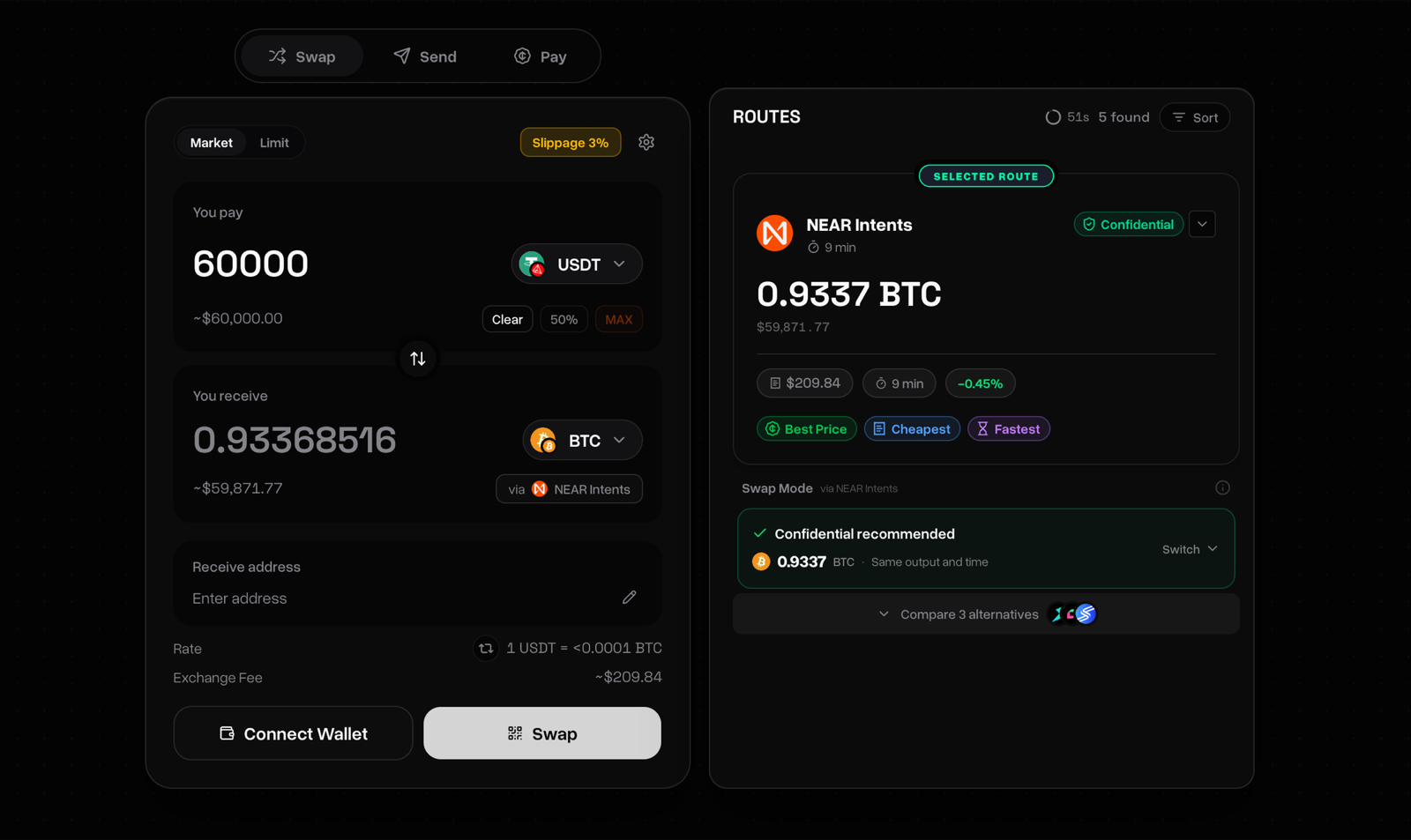
On LeoDex, you don't do anything special. Quote a swap; when a NEAR Intents route wins, we fetch a second, confidential quote in parallel and show you both — Normal and Confidential, side by side, with the exact difference in output.07 One toggle, no new wallet, no account, no KYC.
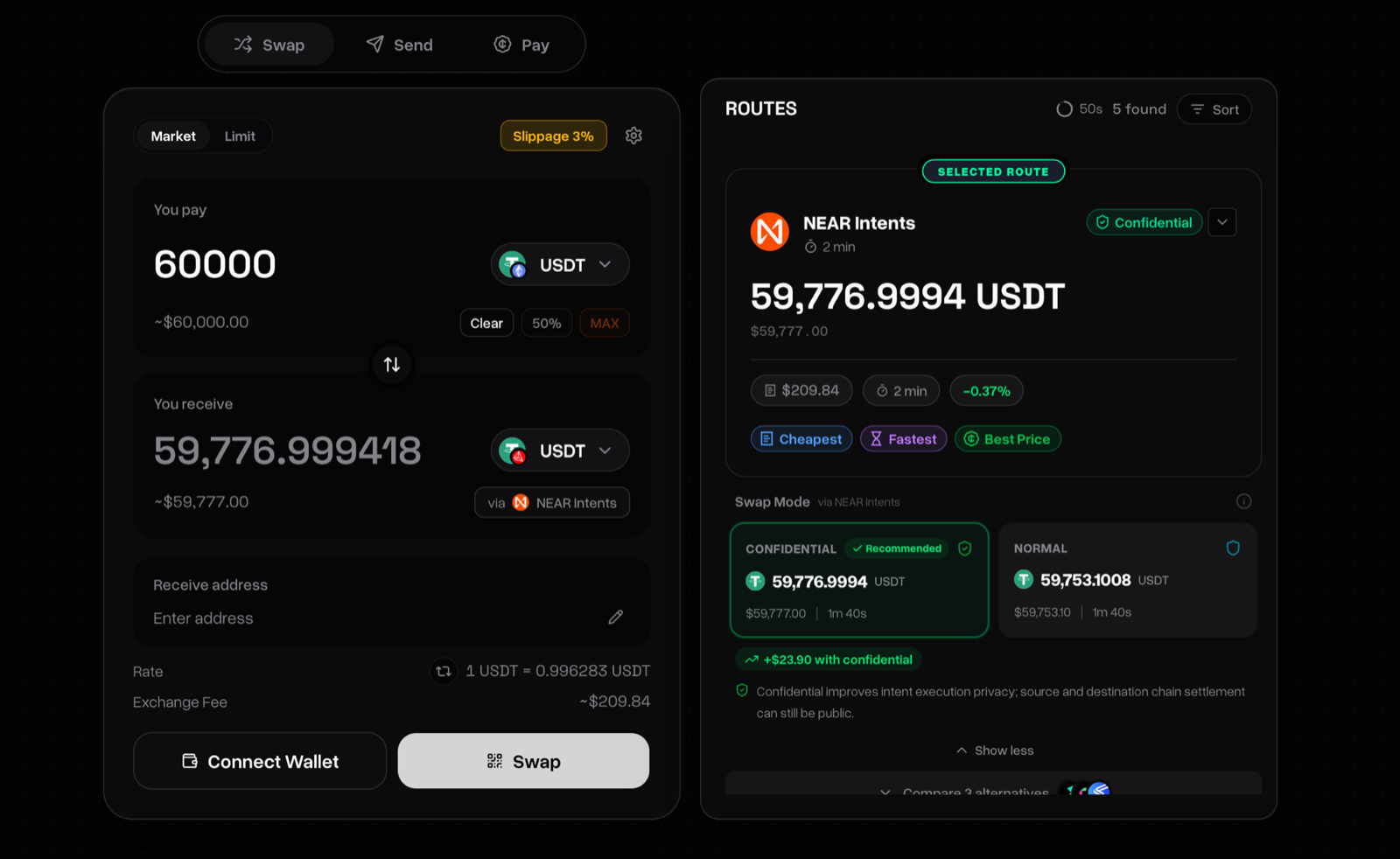
Sometimes confidential execution is simply the better trade, as above. When the confidential quote matches or beats the normal one, we recommend it by default; when it costs something, the difference is on screen before you commit. Either way, the route card and your transaction history carry a Confidential badge, so you can always tell which mode a swap used. The same toggle exists on AnyPay for payments.
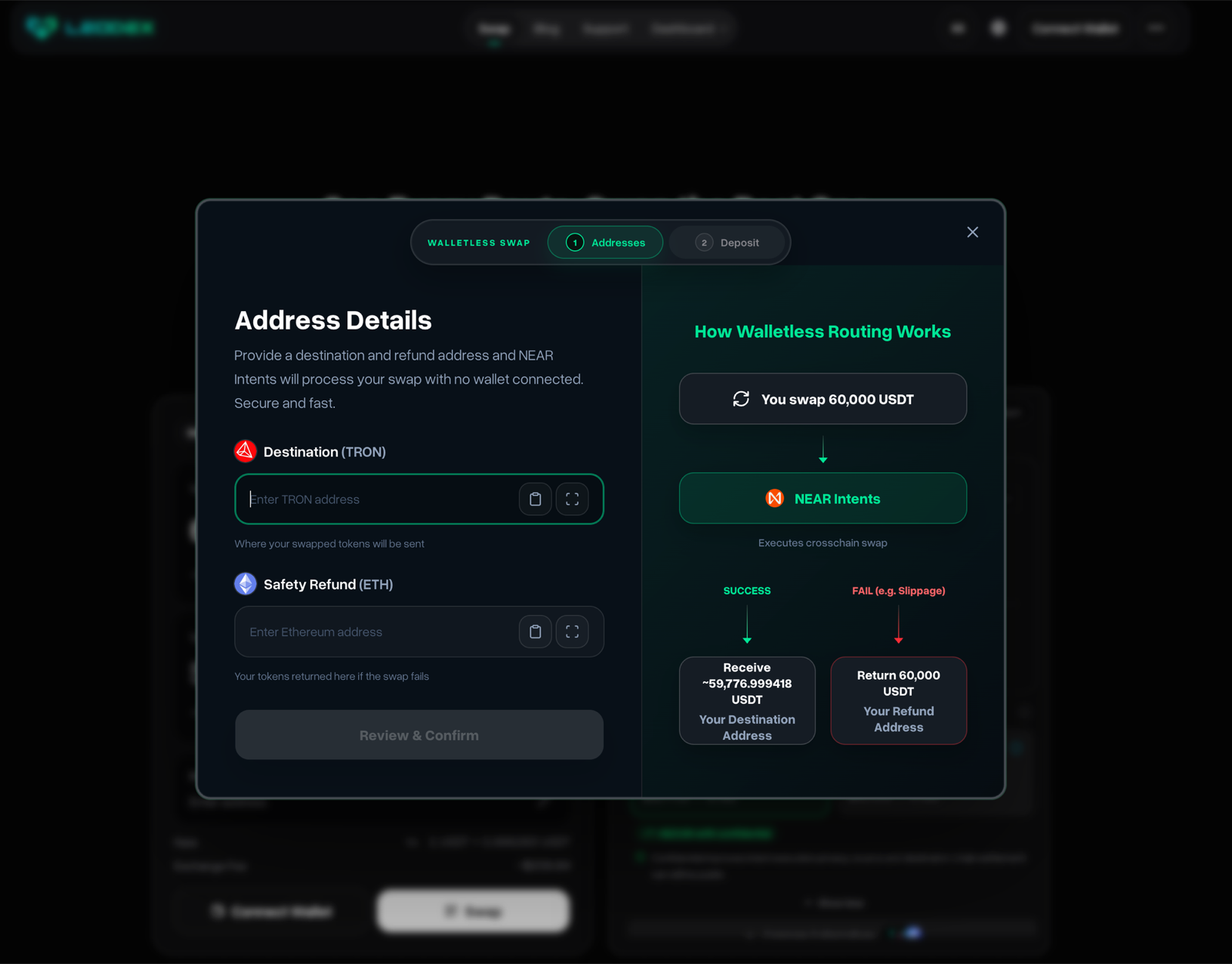
It even works with no wallet connected: give a destination address and a refund address, send funds to the deposit address, and NEAR Intents executes the swap — success pays your destination, failure refunds you.
If confidential execution is not available for a pair, we say so instead of silently downgrading. V1 uses the standard 1Click confidentiality flag; embedded confidential balances are a later chapter.
Privacy in DeFi used to mean leaving — for a mixer, a specialty chain, a privacy coin. The structural change here is privacy inside the flow you already use: one toggle away, opt-in per trade, compliance-compatible, and refusable when you don't need it.
Survive > maximise. Close the curtains. Swap without broadcasting.
Preguntas frecuentes
Q.What are NEAR Confidential Intents?
A privacy feature of NEAR Intents that executes cross-chain transactions in a restricted-visibility environment, so the sender, amounts, and routing never appear on public explorers. You declare the swap you want; solvers fill it privately; settlement guarantees stay intact.
Q.How do confidential intents work technically?
Execution happens on a dedicated NEAR private shard with no public RPC, mempool, or block explorer, run by a permissioned validator set and connected to mainnet through a bridge secured by trusted execution environments (TEEs). No zero-knowledge proofs are generated on your device.
Q.What does a confidential swap hide — and what stays public?
Hidden: your address, the amounts, and the routing path, from explorers, mempools, and RPC observers. Still visible: the edges — funds entering and leaving the confidential environment land on public chains, and the destination payout appears as a normal transfer from a bridge or solver address.
Q.Are confidential intents a mixer? Is this legal?
No. The design supports selective disclosure — you can prove your own history to an auditor without publishing it — and NEAR runs a screening layer (SHIELD) against illicit flows. It is confidentiality with a compliance posture, which is precisely how it differs from mixers.
Q.How do I make a confidential swap?
On LeoDex, quote a swap where NEAR Intents wins the route. A Normal-vs-Confidential toggle appears automatically with the exact output difference between the two modes. Flip it to Confidential and swap — no account, no KYC, and it even works without connecting a wallet.
Q.Do confidential swaps cost more or take longer?
NEAR claims identical speed and cost to public execution; treat that as a vendor claim. On LeoDex you don't have to guess — both quotes render side by side, and sometimes the confidential fill is actually better, so the exact price of confidentiality is on screen before you commit.
Referencias y fuentes
Sources are grouped by type: NEAR's own announcement and documentation for the architecture and rollout, third-party coverage for market data, and LeoDex's product for the integration. Where a claim rests only on NEAR's marketing (MEV elimination, zero overhead), the body says so. All URLs verified July 10, 2026.
NEAR: Primary Sources
- [01]“Confidential Intents — official announcement (private shard, TEE bridge, use cases, staged rollout)”. near.org www.near.org/blog/confidential-intents
- [02]“NEAR Intents documentation — intent model, solver network, Verifier settlement, SHIELD screening”. docs.near-intents.org docs.near-intents.org/
- [03]“1Click API — the integration surface carrying the confidentiality flag”. docs.near-intents.org docs.near-intents.org/integration/distribution-channels/1click-api/about-1click-api
- [04]“NEAR Intents settlement contracts — the Verifier, deployed at intents.near”. github.com github.com/near/intents
Coverage & Data
- [05]“NEAR token jumps 17% after Confidential Intents launch outpaces privacy-tokens sector”. coindesk.com www.coindesk.com/markets/2026/03/02/near-token-jumps-17-after-confidential-intents-launch-outpaces-privacy-tokens-sector
- [06]“NEAR Intents public explorer — what standard (non-confidential) settlements expose”. explorer.near-intents.org explorer.near-intents.org/
LeoDex
- [07]“LeoDex — confidential swap mode (Normal vs Confidential quote comparison)”. leodex.io leodex.io